Vol. 3 Núm. 3 (2026) 
Vol. 3 Núm. 2 (2026) 

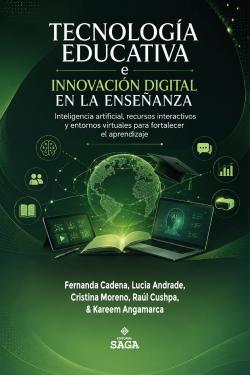
La transformación de la educación mediante tecnologías digitales impulsa nuevas formas de diseñar, desarrollar y evaluar experiencias formativas orientadas al fortalecimiento del aprendizaje, la construcción colaborativa del conocimiento y el desarrollo de competencias digitales en docentes y estudiantes. Tecnología educativa e innovación digital en la enseñanza: Inteligencia artificial, recursos interactivos y entornos virtuales para fortalecer el aprendizaje presenta una visión académica sobre la incorporación de la inteligencia artificial, los recursos interactivos y los entornos virtuales dentro de propuestas pedagógicas que favorecen la personalización, la accesibilidad, la creatividad, la participación activa y la toma de decisiones sustentadas en analítica educativa, articulando referentes teóricos, modelos de diseño instruccional, estrategias metodológicas y experiencias aplicadas que respaldan prácticas educativas de alta calidad. La obra examina el potencial de plataformas inteligentes, herramientas multimedia, laboratorios virtuales, simuladores, realidad aumentada, realidad virtual y sistemas de evaluación digital para enriquecer los procesos de enseñanza y aprendizaje, promoviendo ambientes formativos flexibles, inclusivos y colaborativos, respaldados por principios éticos, gobernanza de datos y uso responsable de la inteligencia artificial. Cada capítulo aporta orientaciones, ejemplos y propuestas transferibles a diversos niveles educativos, favoreciendo la innovación pedagógica, la mejora continua de la práctica docente y la consolidación de una cultura digital orientada al aprendizaje permanente.
Al-Ansi, A. M., Jaboob, M., Garad, A., & Al-Ansi, A. (2023). Analyzing augmented reality (AR) and virtual reality (VR) recent development in education. Social Sciences & Humanities Open, 8(1), 100532. https://doi.org/10.1016/j.ssaho.2023.100532
Alé-Ruiz, R., Martínez-Abad, F., & del Moral-Marcos, M. T. (2024). Academic engagement and management of personalised active learning in higher education digital ecosystems. Education and Information Technologies, 29, 12289–12304. https://doi.org/10.1007/s10639-023-12358-4
Alfiras, M. I. I., Emran, A. Q., & Mohamed, A. M. (2026). Ethics and governance of generative AI in education: A systematic review on responsible adoption. Discover Education, 5, 37. https://doi.org/10.1007/s44217-025-01051-y
Bánhegyi, M., & Fajt, B. (2022). University students’ autonomous learning behaviors in three different modes of ICT-based instruction in the COVID-19 era: A case study of lockdown learning. Studies in Self-Access Learning Journal, 13(1), 5–30. https://doi.org/10.37237/130102
Basilotta-Gómez-Pablos, V., Matarranz, M., Casado-Aranda, L.-A., & Otto, A. (2022). Teachers’ digital competencies in higher education: A systematic literature review. International Journal of Educational Technology in Higher Education, 19, 8. https://doi.org/10.1186/s41239-021-00312-8
Bewersdorff, A., Hartmann, C., Hornberger, M., Seßler, K., Bannert, M., Kasneci, E., Kasneci, G., Zhai, X., & Nerdel, C. (2025). Taking the next step with generative artificial intelligence: The transformative role of multimodal large language models in science education. Learning and Individual Differences, 118, 102601. https://doi.org/10.1016/j.lindif.2024.102601
Bojórquez-Roque, M. S., Garcia-Cabot, A., Garcia-Lopez, E., & Oliva-Córdova, L. M. (2024). Digital competence learning ecosystem in higher education: A mapping and systematic review of the literature. IEEE Access, 12, 87596–87614. https://doi.org/10.1109/ACCESS.2024.3416906
Elmoazen, R., Saqr, M., Khalil, M., & Wasson, B. (2023). Learning analytics in virtual laboratories: A systematic literature review of empirical research. Smart Learning Environments, 10(1), 23. https://doi.org/10.1186/s40561-023-00244-y
Gao, R., Merzdorf, H. E., Anwar, S., Hipwell, M. C., & Srinivasa, A. R. (2024). Automatic assessment of text-based responses in post-secondary education: A systematic review. Computers & Education: Artificial Intelligence, 6, 100206. https://doi.org/10.1016/j.caeai.2024.100206
Hinderliter, H. (2022). Principles of accessible multimedia learning. The Journal of Applied Instructional Design, 11(4), 77–87. https://doi.org/10.59668/423.8402
Kerimbayev, N., Umirzakova, Z., Shadiev, R., & Jotsov, V. (2023). A student-centered approach using modern technologies in distance learning: A systematic review of the literature. Smart Learning Environments, 10, 61. https://doi.org/10.1186/s40561-023-00280-8
Lee, D., & Palmer, E. (2025). Prompt engineering in higher education: A systematic review to help inform curricula. International Journal of Educational Technology in Higher Education, 22, 7. https://doi.org/10.1186/s41239-025-00503-7
Létourneau, A., Deslandes Martineau, M., Charland, P., Karran, J. A., Boasen, J., & Léger, P. M. (2025). A systematic review of AI-driven intelligent tutoring systems (ITS) in K-12 education. npj Science of Learning, 10(1), 29. https://doi.org/10.1038/s41539-025-00320-7
Li, J., & Liang, W. (2024). Effectiveness of virtual laboratory in engineering education: A meta-analysis. PLOS ONE, 19(12), e0316269. https://doi.org/10.1371/journal.pone.0316269
Li, S. E., Singh, K. P., Riedel, N., Yu, F., & Jahnke, I. (2022). Digital learning experience design and research of a self-paced online course for risk-based inspection of food imports. Food Control, 135, 108698. https://doi.org/10.1016/j.foodcont.2021.108698
Mazandarani, A. A., & Taghaddomi, M. S. (2026). A systematic review on recent pedagogical principles for designing digital learning environments: Proposing the SAFE model. Journal of Computer Assisted Learning, 42(2), e70202. https://doi.org/10.1002/jcal.70202
Meletiadou, E. (2022). Using educational digital storytelling to enhance multilingual students’ writing skills in higher education. IAFOR Journal of Education, 10(2), 111–130. https://doi.org/10.22492/ije.10.2.06
Modise, M.-E. P., & Dlamini, N. P. (2026). HyFlex learning in higher education across the Global South and Asia: A systematic review. Open Praxis, 18(1), 86–103. https://doi.org/10.55982/openpraxis.18.1.969
Nguyen, L. T., & Tuamsuk, K. (2022). Digital learning ecosystem at educational institutions: A content analysis of scholarly discourse. Cogent Education, 9(1), 2111033. https://doi.org/10.1080/2331186X.2022.2111033
Ogunleye, B., Zakariyyah, K. I., Ajao, O., Olayinka, O., & Sharma, H. (2024). A systematic review of generative AI for teaching and learning practice. Education Sciences, 14(6), 636. https://doi.org/10.3390/educsci14060636
Ortiz-Andrade, B. M., Rojas-Pérez, A., & Ortiz-Andrade, M. P. (2026). Artificial intelligence in interdisciplinary project-based learning: Student perceptions across five dimensions. American Journal of STEM Education, 20, 1–24. https://doi.org/10.32674/hb1g4f42
Ransanz Reyes, E., Arana-Cuenca, A., & Manzanal Martínez, A. I. (2025). Recommendations for designing collaborative activities in online higher education: A systematic review. Journal of Technology and Science Education, 15(1), 4–17. https://doi.org/10.3926/jotse.2818
Rojas, M. P., & Chiappe, A. (2024). Artificial intelligence and digital ecosystems in education: A review. Technology, Knowledge and Learning, 29, 2153–2170. https://doi.org/10.1007/s10758-024-09732-7
Sanchez, L., Penarreta, J., & Soria Poma, X. (2024). Learning management systems for higher education: A brief comparison. Discover Education, 3, 58. https://doi.org/10.1007/s44217-024-00143-5
Shahidi Hamedani, S., Aslam, S., Mundher Oraibi, B. A., Wah, Y. B., & Shahidi Hamedani, S. (2024). Transitioning towards tomorrow’s workforce: Education 5.0 in the landscape of Society 5.0: A systematic literature review. Education Sciences, 14(10), 1041. https://doi.org/10.3390/educsci14101041
She, L., & Martin, F. (2022). Systematic review (2000 to 2021) of online accessibility research in higher education. American Journal of Distance Education, 36(4), 327–346. https://doi.org/10.1080/08923647.2022.2081438
Tang, D. M., Nguyen, C. T. N., Bui, H. N., Nguyen, H. T., Le, K. T., Truong, K. L. G., Tran, N. T., Vo, N. K., & Nguyen, T. T. (2023). Mobile learning in mathematics education: A systematic literature review of empirical research. Eurasia Journal of Mathematics, Science and Technology Education, 19(5), em2268. https://doi.org/10.29333/ejmste/13162
Witthöft, J., Aydin, B., & Pietsch, M. (2025). Leading digital innovation in schools: The role of the open innovation mindset. Journal of Research on Technology in Education, 57(6), 1430–1449. https://doi.org/10.1080/15391523.2024.2398528
Zeng, J., Sun, D., Looi, C.-K., & Fan, A. C. W. (2024). Exploring the impact of gamification on students’ academic performance: A comprehensive meta-analysis of studies from the year 2008 to 2023. British Journal of Educational Technology, 55(6), 2478–2502. https://doi.org/10.1111/bjet.13471
Zhang, P., & Tur, G. (2024). A systematic review of e-portfolio use during the pandemic: Inspiration for post-COVID-19 practices. Open Praxis, 16(3), 429–444. https://doi.org/10.55982/openpraxis.16.3.656
Vol. 3 Núm. 3 (2026)
Vol. 3 Núm. 2 (2026)










 10 de agosto 232 entre Almendros y Mangos, Cdla. Alborada sector 2, Machala, Ecuador
 editorialsaga.ec@gmail.com
 +593962679148