Vol. 3 Núm. 3 (2026) 
Vol. 3 Núm. 2 (2026) 

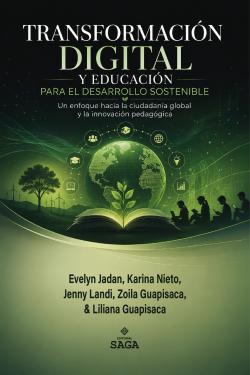
Transformación digital y educación para el desarrollo sostenible: Un enfoque hacia la ciudadanía global y la innovación pedagógica presenta una perspectiva interdisciplinaria sobre las relaciones entre tecnologías digitales, educación, sostenibilidad y formación ciudadana, mediante un recorrido que articula marcos conceptuales, enfoques pedagógicos y aplicaciones educativas orientadas a la transformación social. La obra analiza la integración de recursos digitales, inteligencia artificial, analítica educativa, experiencias inmersivas y metodologías activas como componentes capaces de renovar los procesos de enseñanza y aprendizaje, fortalecer competencias digitales y promover una participación responsable ante problemáticas sociales, ambientales y culturales. Desde una visión educativa comprometida con la equidad, la ética y los derechos humanos, se examinan la ciudadanía global digital, la alfabetización mediática, el pensamiento crítico, la interculturalidad y la cooperación como dimensiones vinculadas con sociedades sostenibles. El libro aborda, además, la formación docente, la innovación social, el aprendizaje-servicio, la acción climática y las redes globales de conocimiento, estableciendo conexiones entre práctica educativa, investigación y transformación comunitaria. Esta propuesta académica ofrece referentes para investigadores, docentes, estudiantes, gestores y responsables de políticas educativas interesados en diseñar ecosistemas de aprendizaje participativos, inclusivos y tecnológicamente responsables, capaces de vincular educación de calidad, conciencia planetaria y compromiso ciudadano.
Adefila, A. (2021). Ecologized collaborative online international learning: Transnational collaboration and environmental citizenship. Journal of Teacher Education for Sustainability. https://doi.org/10.2478/jtes-2021-0004
Aeschbach, V. M. J. (2025). Effectiveness of climate change education: A meta-analysis. Frontiers in Education, 10, 1563816. https://doi.org/10.3389/feduc.2025.1563816
Alenezi, M., Wardat, S., & Akour, M. (2023). The need of integrating digital education in higher education: Challenges and opportunities. Sustainability, 15(6), 4782. https://doi.org/10.3390/su15064782
Alifah, N., & Hidayat, A. R. (2025). Effectiveness of artificial intelligence-based learning analytics tool in supporting personalized learning in higher education. Jurnal Pendidikan Progresif, 15(1). https://doi.org/10.23960/jpp.v15.i1.202506
Almén, L., & Bagga-Gupta, S. (2023). Digital tools and social-ecological sustainability: Going beyond mainstream ways of understanding the roles of tools in contemporary eduscapes. Frontiers in Education, 8, 1147402. https://doi.org/10.3389/feduc.2023.1147402
Alqurni, J. (2026). Sustainable adoption of artificial intelligence and the metaverse in higher education through environmental, social, and governance perspectives. Frontiers in Artificial Intelligence, 9, 1738730. https://doi.org/10.3389/frai.2026.1738730
Al-Shaer, N. E. M. (2025). Digital transformation in higher education for achieving sustainable development goals: A case study. Frontiers in Human Dynamics, 7, 1585538. https://doi.org/10.3389/fhumd.2025.1585538
Alvarez-Guayara, D. L. (2026). Advancing environmental literacy for the SDGs in virtual education environments. Sustainability, 18(3), 1492. https://www.mdpi.com/2071-1050/18/3/1492
Aramburuzabala, P. (2024). Service-learning and digital empowerment: The potential for contributing to sustainable development. Sustainability, 16(6), 2448. https://www.mdpi.com/2071-1050/16/6/2448
Asimakopoulos, G. (2025). Impact of information and communication technologies on citizen participation and democratic processes. Societies, 15(2), 40. https://www.mdpi.com/2075-4698/15/2/40
Auquilla Clavijo, S., Chuqui-Calle, D., Cabrera-Coraisaca, G., López-Morocho, F., Rodríguez Zúñiga, A. P., & Cedillo, P. (2026). Systematic review: Inclusivity and sustainability in educational spaces through technology. Frontiers in Computer Science, 8, 1805171. https://doi.org/10.3389/fcomp.2026.1805171
Castaño, C. (2025). Developing sustainability competencies through active learning methodologies. Sustainability, 17, 8886. https://www.mdpi.com/2071-1050/17/19/8886
Conti, L. (2025). Intercultural education: Recalibrating meanings, objectives and practices in a complex and digitalised world. Intercultural Education. https://doi.org/10.1080/14675986.2025.2484514
David, J. O. (2025). Redefining assessment for sustainability: A reflective approach to curriculum transformation in environmental education. Frontiers in Education, 10, 1553999. https://doi.org/10.3389/feduc.2025.1553999
Deroncele-Acosta, A., Palacios-Núñez, M. L., & Toribio-López, A. (2023). Digital transformation and technological innovation on higher education post-COVID-19. Sustainability, 15(3), 2466. https://doi.org/10.3390/su15032466
Dringó-Horváth, I., Rajki, Z., & T. Nagy, J. (2025). University teachers’ digital competence and AI literacy: Moderating role of gender, age, experience, and discipline. Education Sciences, 15(7), 868. https://doi.org/10.3390/educsci15070868
Echegoyen-Sanz, Y. (2024). Transdisciplinary education for sustainability: Creativity and collaborative learning in teacher education. Frontiers in Education, 8, 1327641. https://doi.org/10.3389/feduc.2023.1327641
Espino-Díaz, L., Luque-González, R., Fernández-Caminero, G., & Álvarez-Castillo, J.-L. (2025). Exploring the impact of project-based learning on Sustainable Development Goals awareness and university students’ growth. European Journal of Educational Research, 14(1), 283–296. https://doi.org/10.12973/eu-jer.14.1.283
Froehlich, D. E. (2023). Sustainable service-learning through massive open online courses. Sustainability, 15(18), 13522. https://www.mdpi.com/2071-1050/15/18/13522
Gauthier, A., Vasalou, A., Tisnes Londoño, A., Wu, N., & Konyani, B. (2025). Empowering young environmental leaders: Designing interactive data visualisation to foster children’s agency in eco-schools. International Journal of Child-Computer Interaction, 44, 100749. https://doi.org/10.1016/j.ijcci.2025.100749
Georgopoulou, M. S. (2025). Digital literacy in higher education: Examining university students’ competencies in the digital age. Computers, 14(12), 528. https://www.mdpi.com/2073-431X/14/12/528
Gerges, E. (2025). Science education in the age of misinformation: Building resilience through scientific media literacy. Frontiers in Education, 10, 1615769. https://doi.org/10.3389/feduc.2025.1615769
Gooding, L. (2025). Aligning digital futures with ecological citizenship for sustainable and equitable technological development. Sustainability, 17(18), 8102. https://www.mdpi.com/2071-1050/17/18/8102
Huang, Y., Zhang, Z., Xu, B., Zhou, X., Zhai, J., & Gao, D. (2025). Digital learning empowering sustainable education. Sustainability, 17, 9060. https://doi.org/10.3390/su17209060
Hwang, G.-J., & Chen, N.-S. (2023). Editorial position paper: Exploring the potential of generative artificial intelligence in education: Applications, challenges, and future research directions. Educational Technology & Society, 26(2), i–xviii. https://doi.org/10.30191/ETS.202304_26(2).0014
Iskandar, R., Maksum, A., & Marini, A. (2025). Digital citizenship literacy in Indonesia: The role of privacy awareness and social campaigns. Social Sciences & Humanities Open, 12, 101697. https://doi.org/10.1016/j.ssaho.2025.101697
Japar, M., Casmana, A. R., Adha, M. M., & Fadhillah, D. N. (2024). Students’ perspectives on civic education through digital citizenship in the virtual era. European Journal of Educational Research, 13(1), 89–102. https://doi.org/10.12973/eu-jer.13.1.89
Lim, J. J. (2026). Building global learning networks: A practical guide for virtual, collaborative postgraduate education. Postgraduate Medical Journal. https://doi.org/10.1093/postmj/qgaf213
Llanos-Ruiz, D. (2025). Virtual reality in higher education: A systematic review aligned with the Sustainable Development Goals. Societies, 15(9), 251. https://www.mdpi.com/2075-4698/15/9/251
Lyu, X. (2024). Social entrepreneurial intention among university students: Sustainability values, opportunity recognition and entrepreneurial competencies. Scientific Reports, 14. https://doi.org/10.1038/s41598-024-58060-4
Manteaw, B. O. (2025). Transgressive pedagogies in a climate-constrained Africa: Learning for climate action and socioecological transformation. Frontiers in Education, 10, 1519914. https://doi.org/10.3389/feduc.2025.1519914
Mimoudi, A. (2025). Generative AI to bridge the educational divide: Personalized learning and challenges. Social Sciences & Humanities Open, 12, 102140. https://doi.org/10.1016/j.ssaho.2025.102140
Mitchell, K., Canham, R., Hughes, K., & Tallentire, V. R. (2025). Simulation-based education and sustainability: Creating a bridge to action. Advances in Simulation, 10, 27. https://doi.org/10.1186/s41077-025-00354-2
Nouri, I. (2025). Impact of immersive virtual reality on environmental mental imagery, climate risk perception and attitudes towards mitigation behaviors. European Journal of Sustainable Development Research, 9(4), em0331. https://doi.org/10.29333/ejosdr/16833
Omar, A. M. (2024). A bibliometric analysis of sustainable digital transformation in higher education in developing countries. Frontiers in Education, 9, 1441644. https://doi.org/10.3389/feduc.2024.1441644
Paul, J. (2026). Digital games in education for sustainable development. Sustainability, 18, 5930. https://www.mdpi.com/2071-1050/18/12/5930
Poo, M. C.-P. (2023). Are virtual laboratories and remote laboratories enhancing the quality of sustainability education? Education Sciences, 13, 1110. https://www.mdpi.com/2227-7102/13/11/1110
Raman, R. (2025). Social entrepreneurship and sustainable technologies: Impact on communities, social innovation and inclusive development. Sustainable Technology and Entrepreneurship. https://www.sciencedirect.com/science/article/pii/S277303282500015X
Rooney-Varga, J. N., Kapmeier, F., Henderson, C., et al. (2024). Community-based propagation to scale up educational innovations in sustainability. Nature Sustainability. https://doi.org/10.1038/s41893-024-01446-z
Schmitt, J. B., Baake, J., & Kero, S. (2024). What means civic education in a digitalized world? Frontiers in Psychology, 15, 1257247. https://doi.org/10.3389/fpsyg.2024.1257247
Senese, A. (2026). Immersive and digital approaches in climate change education. Sustainability, 18(4), 1903. https://www.mdpi.com/2071-1050/18/4/1903
Suguna, M. (2024). Entrepreneurial education and its role in fostering sustainable communities. Scientific Reports, 14. https://doi.org/10.1038/s41598-024-57470-8
Talavera-Mendoza, F., Cahuana Suni, N. R., & Cayani Caceres, K. S. (2025). Fostering ecological awareness and pro-environmental intentions through gamification in high school students. Frontiers in Education, 10, 1650480. https://doi.org/10.3389/feduc.2025.1650480
Tan, X., Cheng, G., & Ling, M. H. (2025). Artificial intelligence in teaching and teacher professional development: A systematic review. Computers and Education: Artificial Intelligence, 8, 100355. https://doi.org/10.1016/j.caeai.2024.100355
Trevisan, L. V., Eustachio, J. H. P. P., Dias, B. G., Leal Filho, W., & Pedrozo, E. Á. (2024). Digital transformation towards sustainability in higher education: State-of-the-art and future research insights. Environment, Development and Sustainability, 26(2), 2789–2810. https://doi.org/10.1007/s10668-022-02874-7
Trixa, J., & Kaspar, K. (2024). Information literacy in the digital age: Information sources, evaluation strategies, and perceived teaching competences of pre-service teachers. Frontiers in Psychology, 15, 1336436. https://doi.org/10.3389/fpsyg.2024.1336436
Vidergor, H. E. (2023). Teaching futures thinking literacy and futures studies in schools and teacher education. Futures, 146. https://www.sciencedirect.com/science/article/abs/pii/S0016328722001823
Wang, T. (2025). Toward glocal citizenship: Rethinking the traditions, goals and practices of intercultural education. Intercultural Education, 36. https://doi.org/10.1080/14675986.2025.2535203
Zhan, Y. (2025). Designing for authentic assessment: A scoping review. Higher Education. https://doi.org/10.1007/s10734-025-01588-9
Zhang, N., & Liu, Y. (2024). Design and implementation of virtual laboratories for higher education sustainability: A case study of Nankai University. Frontiers in Education, 8, 1322263. https://doi.org/10.3389/feduc.2023.1322263
Zhang, X., Zhang, P., Shen, Y., Liu, M., Wang, Q., Gašević, D., & Fan, Y. (2024). A systematic literature review of empirical research on applying generative artificial intelligence in education. Frontiers of Digital Education, 1(3), 223–245. https://doi.org/10.1007/s44366-024-0028-5
Zhang, Y. (2025). Virtual reality for sustainable and responsible pedagogy in art and design education: A systematic review. Computers and Education: X Reality. https://www.sciencedirect.com/science/article/pii/S2666784325000622
Zou, Y. (2025). Digital learning in the 21st century: Trends, challenges, and innovations. Frontiers in Education, 10, 1562391. https://doi.org/10.3389/feduc.2025.1562391
Vol. 3 Núm. 3 (2026)
Vol. 3 Núm. 2 (2026)









 10 de agosto 232 entre Almendros y Mangos, Cdla. Alborada sector 2, Machala, Ecuador
 editorialsaga.ec@gmail.com
 +593962679148