Vol. 3 Núm. 3 (2026) 
Vol. 3 Núm. 2 (2026) 

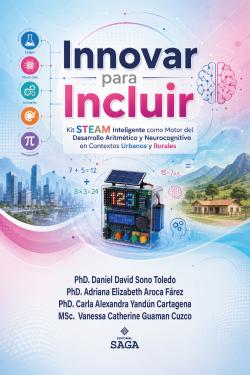
Esta obra presenta una investigación interdisciplinaria orientada al diseño, implementación y evaluación de un Kit STEAM inteligente y sustentable, concebido para fortalecer el aprendizaje aritmético y las capacidades neurocognitivas de niños de ocho a nueve años en instituciones educativas urbanas y rurales del Ecuador. Desde una perspectiva que articula educación STEAM, neurociencia cognitiva, constructivismo e innovación tecnológica, el libro examina las desigualdades de acceso a recursos digitales y plantea una alternativa educativa accesible, de bajo costo y alimentada mediante energías renovables. El prototipo integra Arduino Mega, interfaz LCD, matriz de LED, recursos auditivos y programación adaptativa para desarrollar actividades aritméticas interactivas con niveles progresivos de dificultad. La investigación adopta un enfoque cuantitativo aplicado y un diseño cuasiexperimental con grupos experimental y control, evaluados mediante pruebas aritméticas, instrumentos neuropsicológicos y análisis estadísticos. Los capítulos presentan resultados relativos al rendimiento matemático, memoria de trabajo, atención, razonamiento lógico y resolución de problemas, junto con comparaciones entre escuelas urbanas y rurales de Imbabura. La obra aporta evidencia para orientar prácticas docentes, decisiones institucionales y políticas de equidad educativa, vinculando accesibilidad tecnológica, sostenibilidad, aprendizaje activo y desarrollo infantil mediante una propuesta transferible a diversos entornos escolares, con potencial de adaptación, escalabilidad y aplicación pedagógica responsable.
Agostini, F., Zoccolotti, P., & Casagrande, M. (2022). Domain-general cognitive skills in children with mathematical difficulties and dyscalculia: A systematic review of the literature. Brain Sciences, 12(2), 239. https://doi.org/10.3390/brainsci12020239
Aguilera, D., & Ortiz-Revilla, J. (2021). STEM vs. STEAM education and student creativity: A systematic literature review. Education Sciences, 11(7), 331. https://doi.org/10.3390/educsci11070331
AlRawi, J. M., & AlKahtani, M. A. (2022). Universal design for learning for educating students with intellectual disabilities: A systematic review. International Journal of Developmental Disabilities, 68(6), 800–808. https://doi.org/10.1080/20473869.2021.1900505
Anaya Figueroa, T., Montalvo Castro, J., Calderón, A. I., & Arispe Alburqueque, C. (2021). Escuelas rurales en el Perú: Factores que acentúan las brechas digitales en tiempos de pandemia (COVID-19) y recomendaciones para reducirlas. Educación, 30(58), 11–33. https://doi.org/10.18800/educacion.202101.001
Ancheta-Arrabal, A., Pulido-Montes, C., & Carvajal-Mardones, V. (2021). Gender digital divide and education in Latin America: A literature review. Education Sciences, 11(12), 804. https://doi.org/10.3390/educsci11120804
Asanov, I., Flores, F., McKenzie, D., Mensmann, M., & Schulte, M. (2021). Remote-learning, time-use, and mental health of Ecuadorian high-school students during the COVID-19 quarantine. World Development, 138, 105225. https://doi.org/10.1016/j.worlddev.2020.105225
Brault Foisy, L.-M., Matejko, A. A., Ansari, D., & Masson, S. (2020). Teachers as orchestrators of neuronal plasticity: Effects of teaching practices on the brain. Mind, Brain, and Education, 14(4), 415–428. https://doi.org/10.1111/mbe.12257
Conde, M. Á., Rodríguez-Sedano, F. J., Fernández-Llamas, C., Gonçalves, J., Lima, J., & García-Peñalvo, F. J. (2021). Fostering STEAM through challenge-based learning, robotics, and physical devices: A systematic mapping literature review. Computer Applications in Engineering Education, 29(1), 46–65. https://doi.org/10.1002/cae.22354
Creswell, J. W., & Creswell, J. D. (2018). Research design: Qualitative, quantitative, and mixed methods approaches (5th ed.). SAGE Publications.
Fernández-Batanero, J. M., Montenegro-Rueda, M., Fernández-Cerero, J., & García-Martínez, I. (2022). Assistive technology for the inclusion of students with disabilities: A systematic review. Educational Technology Research and Development, 70(5), 1911–1930. https://doi.org/10.1007/s11423-022-10127-7
Fernández García, L., Merchán, A., Phillips-Silver, J., & Daza González, M. T. (2021). Neuropsychological development of cool and hot executive functions between 6 and 12 years of age: A systematic review. Frontiers in Psychology, 12, 687337. https://doi.org/10.3389/fpsyg.2021.687337
García-Tudela, P. A., & Marín-Marín, J.-A. (2023). Use of Arduino in primary education: A systematic review. Education Sciences, 13(2), 134. https://doi.org/10.3390/educsci13020134
Granić, A. (2022). Educational technology adoption: A systematic review. Education and Information Technologies, 27(7), 9725–9744. https://doi.org/10.1007/s10639-022-10951-7
Guerin, J. M., Wade, S. L., & Mano, Q. R. (2021). Does reasoning training improve fluid reasoning and academic achievement for children and adolescents? A systematic review. Trends in Neuroscience and Education, 23, 100153. https://doi.org/10.1016/j.tine.2021.100153
Hoque, F., Yasin, R. M., & Sopian, K. (2022). Revisiting education for sustainable development: Methods to inspire secondary school students toward renewable energy. Sustainability, 14(14), 8296. https://doi.org/10.3390/su14148296
Kandpal, T. C., & Broman, L. (2014). Renewable energy education: A global status review. Renewable and Sustainable Energy Reviews, 34, 300–324. https://doi.org/10.1016/j.rser.2014.02.039
Kraft, M. A. (2020). Interpreting effect sizes of education interventions. Educational Researcher, 49(4), 241–253. https://doi.org/10.3102/0013189X20912798
Lachney, M., & Foster, E. K. (2020). Historicizing making and doing: Seymour Papert, Sherry Turkle, and epistemological foundations of the maker movement. History and Technology, 36(1), 54–82. https://doi.org/10.1080/07341512.2020.1759302
Levin, I., Semenov, A. L., & Gorsky, M. (2025). Smart learning in the 21st century: Advancing constructionism across three digital epochs. Education Sciences, 15(1), 45. https://doi.org/10.3390/educsci15010045
Li, Y., Wu, X., Ye, D., Zuo, J., & Liu, L. (2025). Research progress on the relationship between fine motor skills and academic ability in children: A systematic review and meta-analysis. Frontiers in Sports and Active Living, 6, 1386967. https://doi.org/10.3389/fspor.2024.1386967
Lin, Q., Yin, Y., Tang, X., Hadad, R., & Zhai, X. (2020). Assessing learning in technology-rich maker activities: A systematic review of empirical research. Computers & Education, 157, 103944. https://doi.org/10.1016/j.compedu.2020.103944
Mejias, S., Thompson, N., Sedas, R. M., Rosin, M., Soep, E., Peppler, K., Roche, J., Wong, J., Hurley, M., Bell, P., & Bevan, B. (2021). The trouble with STEAM and why we use it anyway. Science Education, 105(2), 209–231. https://doi.org/10.1002/sce.21605
Menon, V., & Chang, H. (2021). Emerging neurodevelopmental perspectives on mathematical learning. Developmental Review, 60, 100964. https://doi.org/10.1016/j.dr.2021.100964
Nelson, G., Crawford, A., Hunt, J., Park, S., Leckie, E., Duarte, A., Brafford, T., Ramos-Duke, M., & Zarate, K. (2022). A systematic review of research syntheses on students with mathematics learning disabilities and difficulties. Learning Disabilities Research & Practice, 37(1), 18–36. https://doi.org/10.1111/ldrp.12272
Ng, S. F., Kamarul Azlan, M. A., Ahmad Kamal, A. N., & Manion, A. (2020). A quasi-experiment on using guided mobile learning interventions in ESL classrooms: Time use and academic performance. Education and Information Technologies, 25, 4699–4719. https://doi.org/10.1007/s10639-020-10191-7
Novak, E., Brannon, M., Librea-Carden, M. R., & Haas, A. L. (2021). A systematic review of empirical research on learning with 3D printing technology. Journal of Computer Assisted Learning, 37(5), 1455–1478. https://doi.org/10.1111/jcal.12585
Outhwaite, L. A., Aunio, P., Leung, J. K. Y., & Van Herwegen, J. (2024). Measuring mathematical skills in early childhood: A systematic review of the psychometric properties of early maths assessments and screeners. Educational Psychology Review, 36, Article 110. https://doi.org/10.1007/s10648-024-09950-6
Ouyang, F., & Xu, W. (2024). The effects of educational robotics in STEM education: A multilevel meta-analysis. International Journal of STEM Education, 11, 7. https://doi.org/10.1186/s40594-024-00469-4
Papert, S. (1980). Mindstorms: Children, computers, and powerful ideas. Basic Books.
Rodríguez-Jiménez, C., de la Cruz-Campos, J.-C., Campos-Soto, M.-N., & Ramos-Navas-Parejo, M. (2023). Teaching and learning mathematics in primary education: The role of ICT—A systematic review of the literature. Mathematics, 11(2), 272. https://doi.org/10.3390/math11020272
Sapounidis, T., Tselegkaridis, S., & Stamovlasis, D. (2023). Educational robotics and STEM in primary education: A review and a meta-analysis. Journal of Research on Technology in Education, 56(4), 462–476. https://doi.org/10.1080/15391523.2022.2160394
Scheiter, K. (2021). Lernen und Lehren mit digitalen Medien: Eine Standortbestimmung [Technology-enhanced learning and teaching: An overview]. Zeitschrift für Erziehungswissenschaft, 24(5), 1039–1060. https://doi.org/10.1007/s11618-021-01047-y
Spiegel, J. A., Goodrich, J. M., Morris, B. M., Osborne, C. M., & Lonigan, C. J. (2021). Relations between executive functions and academic outcomes in elementary school children: A meta-analysis. Psychological Bulletin, 147(4), 329–351. https://doi.org/10.1037/bul0000322
Stinson, H. (2022). Impacts of remote learning measures on educational access and quality in Ecuador. Current Issues in Comparative Education, 24(2). https://doi.org/10.52214/cice.v24i2.9513
Vogel, S. E., & De Smedt, B. (2021). Developmental brain dynamics of numerical and arithmetic abilities. npj Science of Learning, 6, 22. https://doi.org/10.1038/s41539-021-00099-3
White, D., & Delaney, S. (2021). Full STEAM ahead, but who has the map? A PRISMA systematic review on the incorporation of interdisciplinary learning into schools. LUMAT: International Journal on Math, Science and Technology Education, 9(2), 9–32. https://doi.org/10.31129/LUMAT.9.2.1387
Zhang, Y., Tolmie, A., & Gordon, R. (2023). The relationship between working memory and arithmetic in primary school children: A meta-analysis. Brain Sciences, 13(1), 22. https://doi.org/10.3390/brainsci13010022
Vol. 3 Núm. 3 (2026)
Vol. 3 Núm. 2 (2026)










 10 de agosto 232 entre Almendros y Mangos, Cdla. Alborada sector 2, Machala, Ecuador
 editorialsaga.ec@gmail.com
 +593962679148