Vol. 3 Núm. 3 (2026) 
Vol. 3 Núm. 2 (2026) 

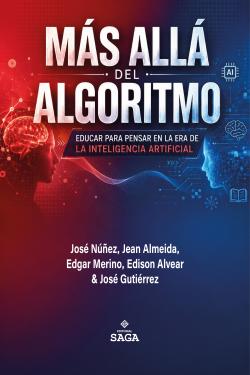
Más allá del algoritmo: Educar para pensar en la era de la inteligencia artificial examina la transformación educativa provocada por la incorporación creciente de sistemas inteligentes en los procesos de enseñanza, aprendizaje y producción del conocimiento, y propone una pedagogía orientada a preservar la autonomía intelectual, el pensamiento crítico y la capacidad creadora. Frente a respuestas automatizadas más convincentes, la obra desplaza la atención desde el dominio instrumental de herramientas hacia la formación de personas capaces de preguntar, contrastar evidencias, reconocer sesgos, argumentar con rigor y decidir responsablemente cuándo recurrir a la inteligencia artificial. Sus capítulos articulan cognición aumentada, metacognición, evaluación auténtica, autoría, integridad académica, privacidad, justicia algorítmica, creatividad y ciudadanía, ofreciendo criterios para comprender las nuevas relaciones entre estudiantes, docentes y tecnologías generativas. El libro reivindica al docente como mediador cognitivo y diseñador de experiencias intelectualmente exigentes, mientras sitúa al estudiante como autor consciente de su aprendizaje. También analiza las implicaciones éticas de delegar decisiones, producir contenidos mediante sistemas generativos y habitar entornos educativos mediados por datos. Más que enseñar a utilizar inteligencia artificial, esta obra defiende una educación capaz de formar criterio, sostener la duda razonada y fortalecer aquello que ninguna automatización debería reemplazar: la libertad de pensar.
Baker, R. S., & Hawn, A. (2022). Algorithmic bias in education. International Journal of Artificial Intelligence in Education, 32(4), 1052–1092. https://doi.org/10.1007/s40593-021-00285-9
Corrin, L. (2021). Shifting to digital: A policy perspective on “Student perceptions of privacy principles for learning analytics”. Educational Technology Research and Development, 69(1), 353–356. https://doi.org/10.1007/s11423-020-09922-x
Črček, N., & Patekar, J. (2023). Writing with AI: University students’ use of ChatGPT. Journal of Language and Education, 9(4). https://doi.org/10.17323/jle.2023.17379
Deng, R., Jiang, M., Yu, X., Lu, Y., & Liu, S. (2025). Does ChatGPT enhance student learning? A systematic review and meta-analysis of experimental studies. Computers & Education, 227, 105224. https://doi.org/10.1016/j.compedu.2024.105224
Fleckenstein, J., Meyer, J., Jansen, T., Keller, S. D., Köller, O., & Möller, J. (2024). Do teachers spot AI? Evaluating the detectability of AI-generated texts among student essays. Computers and Education: Artificial Intelligence, 6, 100209. https://doi.org/10.1016/j.caeai.2024.100209
Foung, D., Lin, L., & Chen, J. (2024). Reinventing assessments with ChatGPT and other online tools: Opportunities for GenAI-empowered assessment practices. Computers and Education: Artificial Intelligence, 6, 100250. https://doi.org/10.1016/j.caeai.2024.100250
Jauhiainen, J. S., & Garagorry Guerra, A. (2024). Generative AI and education: Dynamic personalization of pupils’ school learning material with ChatGPT. Frontiers in Education, 9, 1288723. https://doi.org/10.3389/feduc.2024.1288723
Kajiwara, Y., & Kawabata, K. (2024). AI literacy for ethical use of chatbot: Will students accept AI ethics? Computers and Education: Artificial Intelligence, 6, 100251. https://doi.org/10.1016/j.caeai.2024.100251
Liang, W., & Wu, Y. (2024). Exploring the use of ChatGPT to foster EFL learners’ critical thinking skills from a post-humanist perspective. Thinking Skills and Creativity, 54, 101645. https://doi.org/10.1016/j.tsc.2024.101645
Lo, C. K., Hew, K. F., & Jong, M. S.-Y. (2024). The influence of ChatGPT on student engagement: A systematic review and future research agenda. Computers & Education, 219, 105100. https://doi.org/10.1016/j.compedu.2024.105100
Lye, C. Y., & Lim, L. (2024). Generative artificial intelligence in tertiary education: Assessment redesign principles and considerations. Education Sciences, 14(6), 569. https://doi.org/10.3390/educsci14060569
Masters, K. (2023). Medical Teacher’s first ChatGPT’s referencing hallucinations: Lessons for editors, reviewers, and teachers. Medical Teacher, 45(7), 673–675. https://doi.org/10.1080/0142159X.2023.2208731
Ng, D. T. K., Tan, C. W., & Leung, J. K. L. (2024). Empowering student self-regulated learning and science education through ChatGPT: A pioneering pilot study. British Journal of Educational Technology, 55(4), 1328–1353. https://doi.org/10.1111/bjet.13454
Orchard, A., & Radke, D. (2023). An analysis of engineering students’ responses to an AI ethics scenario. Proceedings of the AAAI Conference on Artificial Intelligence, 37(13), 15834–15842. https://doi.org/10.1609/aaai.v37i13.26880
Soffer, T., & Cohen, A. (2024). Privacy versus pedagogy – students’ perceptions of using learning analytics in higher education. Australasian Journal of Educational Technology, 40(5), 14–30. https://doi.org/10.14742/ajet.9130
Toma, R. B., & Yánez-Pérez, I. (2024). Effects of ChatGPT use on undergraduate students’ creativity: A threat to creative thinking? Discover Artificial Intelligence, 4, 74. https://doi.org/10.1007/s44163-024-00172-x
Urban, M., Děchtěrenko, F., Lukavský, J., Hrabalová, V., Svacha, F., Brom, C., & Urban, K. (2024). ChatGPT improves creative problem-solving performance in university students: An experimental study. Computers & Education, 215, 105031. https://doi.org/10.1016/j.compedu.2024.105031
Usher, M., & Barak, M. (2024). Unpacking the role of AI ethics online education for science and engineering students. International Journal of STEM Education, 11, 35. https://doi.org/10.1186/s40594-024-00493-4
Walter, Y. (2024). Embracing the future of artificial intelligence in the classroom: The relevance of AI literacy, prompt engineering, and critical thinking in modern education. International Journal of Educational Technology in Higher Education, 21, 15. https://doi.org/10.1186/s41239-024-00448-3
Yacobson, E., Fuhrman, O., Hershkovitz, S., & Alexandron, G. (2021). De-identification is insufficient to protect student privacy, or – What can a field trip reveal? Journal of Learning Analytics, 8(2), 83–92. https://doi.org/10.18608/jla.2021.7353
Yan, W., Nakajima, T., & Sawada, R. (2024). Benefits and challenges of collaboration between students and conversational generative artificial intelligence in programming learning: An empirical case study. Education Sciences, 14(4), 433. https://doi.org/10.3390/educsci14040433
Zhai, C., Wibowo, S., & Li, L. D. (2024). The effects of over-reliance on AI dialogue systems on students’ cognitive abilities: A systematic review. Smart Learning Environments, 11, 28. https://doi.org/10.1186/s40561-024-00316-7
Vol. 3 Núm. 3 (2026)
Vol. 3 Núm. 2 (2026)










 10 de agosto 232 entre Almendros y Mangos, Cdla. Alborada sector 2, Machala, Ecuador
 editorialsaga.ec@gmail.com
 +593962679148