Vol. 3 Núm. 3 (2026) 
Vol. 3 Núm. 2 (2026) 

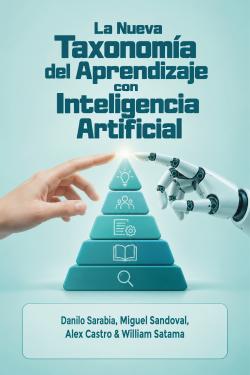
La Nueva Taxonomía del Aprendizaje con IA propone una reinterpretación crítica de Bloom y de otros modelos cognitivos ante la incorporación de inteligencia artificial generativa en la educación. La obra examina la transformación de operaciones como recordar, comprender, aplicar, analizar, evaluar y crear cuando estudiantes y sistemas algorítmicos participan conjuntamente en la producción, revisión y validación del conocimiento. Desde una perspectiva interdisciplinaria, articula aportes de la psicología cognitiva, la pedagogía, la metacognición y la cognición distribuida para distinguir pensamiento autónomo, cognición aumentada, interacción dialógica, delegación algorítmica, supervisión epistémica y regulación metagenerativa. El argumento central desplaza la atención desde la ejecución observable hacia la arquitectura intelectual que sostiene cada desempeño. También examina la descarga cognitiva, la agencia del estudiante, la verificación de contenidos sintéticos y la fricción cognitiva deliberada como variables para diseñar experiencias formativas. A partir de dicha reformulación, el libro plantea criterios para construir resultados de aprendizaje, actividades, rúbricas y evaluaciones capaces de diferenciar producción automatizada, coautoría humano-máquina y dominio intelectual verificable. La propuesta culmina en una matriz multidimensional que relaciona complejidad cognitiva, autonomía, mediación algorítmica, responsabilidad epistémica, transferencia y evidencia, ofreciendo un lenguaje renovado para investigar, diseñar y evaluar el aprendizaje universitario contemporáneo en ecosistemas educativos mediados digitalmente.
Abd-alrazaq, A., AlSaad, R., Alhuwail, D., Ahmed, A., Healy, P. M., Latifi, S., Aziz, S., Damseh, R., Alabed Alrazak, S., & Sheikh, J. (2023). Large language models in medical education: Opportunities, challenges, and future directions. JMIR Medical Education, 9, e48291. https://doi.org/10.2196/48291
Almazrou, S., Alanezi, F., Almutairi, S. A., AboAlsamh, H. M., Alsedrah, I. T., Arif, W. M., Alsadhan, A. A., AlSanad, D. S., Alqahtani, N. S., AlShammary, M. H., Bakhshwain, A. M., Almuhanna, A. F., Almulhem, M., Alnaim, N., Albelali, S., & Attar, R. W. (2024). Enhancing medical students critical thinking skills through ChatGPT: An empirical study with medical students. Nutrition and Health, 31(3), 1023–1033. https://doi.org/10.1177/02601060241273627
Banihashem, S. K., Kerman, N. T., Noroozi, O., Moon, J., & Drachsler, H. (2024). Feedback sources in essay writing: Peer-generated or AI-generated feedback?. International Journal of Educational Technology in Higher Education, 21(1), 23. https://doi.org/10.1186/s41239-024-00455-4
Barrett, A., & Pack, A. (2023). Not quite eye to A.I.: Student and teacher perspectives on the use of generative artificial intelligence in the writing process. International Journal of Educational Technology in Higher Education, 20(1), 59. https://doi.org/10.1186/s41239-023-00427-0
Celik, I. (2023). Towards Intelligent-TPACK: An empirical study on teachers’ professional knowledge to ethically integrate artificial intelligence (AI)-based tools into education. Computers in Human Behavior, 138, 107468. https://doi.org/10.1016/j.chb.2022.107468
Chan, C. K. Y. (2023). A comprehensive AI policy education framework for university teaching and learning. International Journal of Educational Technology in Higher Education, 20(1), 38. https://doi.org/10.1186/s41239-023-00408-3
Chan, C. K. Y., & Hu, W. (2023). Students’ voices on generative AI: Perceptions, benefits, and challenges in higher education. International Journal of Educational Technology in Higher Education, 20(1), 43. https://doi.org/10.1186/s41239-023-00411-8
Chan, C. K. Y., & Lee, K. K. W. (2023). The AI generation gap: Are gen z students more interested in adopting generative AI such as ChatGPT in teaching and learning than their gen x and millennial generation teachers?. Smart Learning Environments, 10(1), 60. https://doi.org/10.1186/s40561-023-00269-3
Chang, D. H., Lin, M. P. C., Hajian, S., & Wang, Q. Q. (2023). Educational design principles of using AI chatbot that supports Self-Regulated learning in education: Goal setting, feedback, and personalization. Sustainability, 15(17), 12921. https://doi.org/10.3390/su151712921
Chen, X., Xie, H., Zou, D., & Hwang, G. J. (2020). Application and theory gaps during the rise of artificial intelligence in education. Computers and Education: Artificial Intelligence, 1, 100002. https://doi.org/10.1016/j.caeai.2020.100002
Chen, L., Chen, P., & Lin, Z. (2020). Artificial intelligence in education: A review. IEEE Access, 8, 75264–75278. https://doi.org/10.1109/access.2020.2988510
Chiu, T. K. F. (2023). The impact of generative AI (GenAI) on practices, policies and research direction in education: A case of ChatGPT and Midjourney. Interactive Learning Environments, 32(10), 6187–6203. https://doi.org/10.1080/10494820.2023.2253861
Cooper, G. (2023). Examining science education in ChatGPT: An exploratory study of generative artificial intelligence. Journal of Science Education and Technology, 32(3), 444–452. https://doi.org/10.1007/s10956-023-10039-y
Cotton, D. R. E., Cotton, P. A., & Shipway, J. R. (2023). Chatting and cheating: Ensuring academic integrity in the era of ChatGPT. Innovations in Education and Teaching International, 61(2), 228–239. https://doi.org/10.1080/14703297.2023.2190148
Crawford, J., Cowling, M., & Allen, K. A. (2023). Leadership is needed for ethical ChatGPT: Character, assessment, and learning using artificial intelligence (AI). Journal of University Teaching and Learning Practice, 20(3). https://doi.org/10.53761/1.20.3.02
Crompton, H., & Burke, D. (2023). Artificial intelligence in higher education: The state of the field. International Journal of Educational Technology in Higher Education, 20(1), 22. https://doi.org/10.1186/s41239-023-00392-8
Darvishi, A., Khosravi, H., Sadiq, S., Gašević, D., & Siemens, G. (2024). Impact of AI assistance on student agency. Computers & Education, 210, 104967. https://doi.org/10.1016/j.compedu.2023.104967
Doshi, A. R., & Hauser, O. P. (2024). Generative AI enhances individual creativity but reduces the collective diversity of novel content. Science Advances, 10(28), eadn5290. https://doi.org/10.1126/sciadv.adn5290
Dwivedi, Y. K., Kshetri, N., Hughes, L., Slade, E. L., Jeyaraj, A., Kar, A. K., Baabdullah, A. M., Koohang, A., Raghavan, V., Ahuja, M., Albanna, H., Albashrawi, M. A., Al-Busaidi, A. S., Balakrishnan, J., Barlette, Y., Basu, S., Bose, I., Brooks, L., Buhalis, D., …, Wright, R. (2023). Opinion paper: “So what if ChatGPT wrote it?” multidisciplinary perspectives on opportunities, challenges and implications of generative conversational AI for research, practice and policy. International Journal of Information Management, 71, 102642. https://doi.org/10.1016/j.ijinfomgt.2023.102642
Díaz-Rodríguez, N., Del Ser, J., Coeckelbergh, M., López de Prado, M., Herrera-Viedma, E., & Herrera, F. (2023). Connecting the dots in trustworthy artificial intelligence: From AI principles, ethics, and key requirements to responsible AI systems and regulation. Information Fusion, 99, 101896. https://doi.org/10.1016/j.inffus.2023.101896
Escalante, J., Pack, A., & Barrett, A. (2023). AI-generated feedback on writing: Insights into efficacy and ENL student preference. International Journal of Educational Technology in Higher Education, 20(1), 57. https://doi.org/10.1186/s41239-023-00425-2
Essel, H. B., Vlachopoulos, D., Essuman, A. B., & Amankwa, J. O. (2024). ChatGPT effects on cognitive skills of undergraduate students: Receiving instant responses from AI-based conversational large language models (LLMs). Computers and Education: Artificial Intelligence, 6, 100198. https://doi.org/10.1016/j.caeai.2023.100198
Fan, Y., Tang, L., Le, H., Shen, K., Tan, S., Zhao, Y., Shen, Y., Li, X., & Gašević, D. (2024). Beware of metacognitive laziness: Effects of generative artificial intelligence on learning motivation, processes, and performance. British Journal of Educational Technology, 56(2), 489–530. https://doi.org/10.1111/bjet.13544
Farrelly, T., & Baker, N. (2023). Generative artificial intelligence: Implications and considerations for higher education practice. Education Sciences, 13(11), 1109. https://doi.org/10.3390/educsci13111109
Gao, C. A., Howard, F. M., Markov, N. S., Dyer, E. C., Ramesh, S., Luo, Y., & Pearson, A. T. (2023). Comparing scientific abstracts generated by ChatGPT to real abstracts with detectors and blinded human reviewers. npj Digital Medicine, 6(1), 75. https://doi.org/10.1038/s41746-023-00819-6
Giannakos, M., Azevedo, R., Brusilovsky, P., Cukurova, M., Dimitriadis, Y., Hernandez-Leo, D., Järvelä, S., Mavrikis, M., & Rienties, B. (2024). The promise and challenges of generative AI in education. Behaviour & Information Technology, 44(11), 2518–2544. https://doi.org/10.1080/0144929x.2024.2394886
Guo, Y., & Lee, D. (2023). Leveraging ChatGPT for enhancing critical thinking skills. Journal of Chemical Education, 100(12), 4876–4883. https://doi.org/10.1021/acs.jchemed.3c00505
Hager, P., Jungmann, F., Holland, R., Bhagat, K., Hubrecht, I., Knauer, M., Vielhauer, J., Makowski, M., Braren, R., Kaissis, G., & Rueckert, D. (2024). Evaluation and mitigation of the limitations of large language models in clinical decision-making. Nature Medicine, 30(9), 2613–2622. https://doi.org/10.1038/s41591-024-03097-1
Halaweh, M. (2023). ChatGPT in education: Strategies for responsible implementation. Contemporary Educational Technology, 15(2), ep421. https://doi.org/10.30935/cedtech/13036
Hicks, M. T., Humphries, J., & Slater, J. (2024). ChatGPT is bullshit. Ethics and Information Technology, 26(2), 38. https://doi.org/10.1007/s10676-024-09775-5
Holmes, W., & Tuomi, I. (2022). State of the art and practice in AI in education. European Journal of Education, 57(4), 542–570. https://doi.org/10.1111/ejed.12533
Hwang, G. J., Xie, H., Wah, B. W., & Gašević, D. (2020). Vision, challenges, roles and research issues of artificial intelligence in education. Computers and Education: Artificial Intelligence, 1, 100001. https://doi.org/10.1016/j.caeai.2020.100001
Ivanov, S., Soliman, M., Tuomi, A., Alkathiri, N. A., & Al-Alawi, A. N. (2024). Drivers of generative AI adoption in higher education through the lens of the theory of planned behaviour. Technology in Society, 77, 102521. https://doi.org/10.1016/j.techsoc.2024.102521
Jakesch, M., Hancock, J. T., & Naaman, M. (2023). Human heuristics for AI-generated language are flawed. Proceedings of the National Academy of Sciences, 120(11), e2208839120. https://doi.org/10.1073/pnas.2208839120
Kasneci, E., Sessler, K., Küchemann, S., Bannert, M., Dementieva, D., Fischer, F., Gasser, U., Groh, G., Günnemann, S., Hüllermeier, E., Krusche, S., Kutyniok, G., Michaeli, T., Nerdel, C., Pfeffer, J., Poquet, O., Sailer, M., Schmidt, A., Seidel, T., …, Kasneci, G. (2023). ChatGPT for good? on opportunities and challenges of large language models for education. Learning and Individual Differences, 103, 102274. https://doi.org/10.1016/j.lindif.2023.102274
Kim, J., Lee, H., & Cho, Y. H. (2022). Learning design to support student-AI collaboration: Perspectives of leading teachers for AI in education. Education and Information Technologies, 27(5), 6069–6104. https://doi.org/10.1007/s10639-021-10831-6
King, M. R., & ChatGPT. (2023). A conversation on artificial intelligence, chatbots, and plagiarism in higher education. Cellular and Molecular Bioengineering, 16(1), 1–2. https://doi.org/10.1007/s12195-022-00754-8
Kung, T. H., Cheatham, M., Medenilla, A., Sillos, C., De Leon, L., Elepaño, C., Madriaga, M., Aggabao, R., Diaz-Candido, G., Maningo, J., & Tseng, V. (2023). Performance of ChatGPT on USMLE: Potential for AI-assisted medical education using large language models. PLOS Digital Health, 2(2), e0000198. https://doi.org/10.1371/journal.pdig.0000198
Laupichler, M. C., Aster, A., Schirch, J., & Raupach, T. (2022). Artificial intelligence literacy in higher and adult education: A scoping literature review. Computers and Education: Artificial Intelligence, 3, 100101. https://doi.org/10.1016/j.caeai.2022.100101
Lee, H. (2023). The rise of ChatGPT : exploring its potential in medical education. Anatomical Sciences Education, 17(5), 926–931. https://doi.org/10.1002/ase.2270
Li, T., Ji, Y., & Zhan, Z. (2024). Expert or machine? comparing the effect of pairing student teacher with in-service teacher and ChatGPT on their critical thinking, learning performance, and cognitive load in an integrated-STEM course. Asia Pacific Journal of Education, 44(1), 45–60. https://doi.org/10.1080/02188791.2024.2305163
Liu, C., Hou, J., Tu, Y. F., Wang, Y., & Hwang, G. J. (2021). Incorporating a reflective thinking promoting mechanism into artificial intelligence-supported english writing environments. Interactive Learning Environments, 31(9), 5614–5632. https://doi.org/10.1080/10494820.2021.2012812
Lo, C. K. (2023). What is the impact of ChatGPT on education? a rapid review of the literature. Education Sciences, 13(4), 410. https://doi.org/10.3390/educsci13040410
Marzuki,, Widiati, U., Rusdin, D., Darwin,, & Indrawati, I. (2023). The impact of AI writing tools on the content and organization of students’ writing: EFL teachers’ perspective. Cogent Education, 10(2), 2236469. https://doi.org/10.1080/2331186x.2023.2236469
Meskó, B. (2023). Prompt engineering as an important emerging skill for medical professionals: Tutorial. Journal of Medical Internet Research, 25, e50638. https://doi.org/10.2196/50638
Ng, D. T. K., Leung, J. K. L., Chu, S. K. W., & Qiao, M. S. (2021). Conceptualizing AI literacy: An exploratory review. Computers and Education: Artificial Intelligence, 2, 100041. https://doi.org/10.1016/j.caeai.2021.100041
Nguyen, A., Ngo, H. N., Hong, Y., Dang, B., & Nguyen, B. P. T. (2022). Ethical principles for artificial intelligence in education. Education and Information Technologies, 28(4), 4221–4241. https://doi.org/10.1007/s10639-022-11316-w
Nguyen, A., Hong, Y., Dang, B., & Huang, X. (2024). Human-AI collaboration patterns in AI-assisted academic writing. Studies in Higher Education, 49(5), 847–864. https://doi.org/10.1080/03075079.2024.2323593
Noy, S., & Zhang, W. (2023). Experimental evidence on the productivity effects of generative artificial intelligence. Science, 381(6654), 187–192. https://doi.org/10.1126/science.adh2586
Owan, V. J., Abang, K. B., Idika, D. O., Etta, E. O., & Bassey, B. A. (2023). Exploring the potential of artificial intelligence tools in educational measurement and assessment. Eurasia Journal of Mathematics, Science and Technology Education, 19(8), em2307. https://doi.org/10.29333/ejmste/13428
O’Connor, S., & ChatGPT. (2023). Open artificial intelligence platforms in nursing education: Tools for academic progress or abuse?. Nurse Education in Practice, 66, 103537. https://doi.org/10.1016/j.nepr.2022.103537
Rahman, M. M., & Watanobe, Y. (2023). ChatGPT for education and research: Opportunities, threats, and strategies. Applied Sciences, 13(9), 5783. https://doi.org/10.3390/app13095783
Romero-Rodríguez, J. M., Ramírez-Montoya, M. S., Buenestado-Fernández, M., & Lara-Lara, F. (2023). Use of ChatGPT at university as a tool for complex thinking: Students’ perceived usefulness. Journal of New Approaches in Educational Research, 12(2), 323–339. https://doi.org/10.7821/naer.2023.7.1458
Seo, K., Tang, J., Roll, I., Fels, S., & Yoon, D. (2021). The impact of artificial intelligence on learner–instructor interaction in online learning. International Journal of Educational Technology in Higher Education, 18(1), 54. https://doi.org/10.1186/s41239-021-00292-9
Song, C., & Song, Y. (2023). Enhancing academic writing skills and motivation: Assessing the efficacy of ChatGPT in AI-assisted language learning for EFL students. Frontiers in Psychology, 14, 1260843. https://doi.org/10.3389/fpsyg.2023.1260843
Stahl, B. C., & Eke, D. (2024). The ethics of ChatGPT – exploring the ethical issues of an emerging technology. International Journal of Information Management, 74, 102700. https://doi.org/10.1016/j.ijinfomgt.2023.102700
Strzelecki, A. (2023). Students’ acceptance of ChatGPT in higher education: An extended unified theory of acceptance and use of technology. Innovative Higher Education, 49(2), 223–245. https://doi.org/10.1007/s10755-023-09686-1
Tam, T. Y. C., Sivarajkumar, S., Kapoor, S., Stolyar, A. V., Polanska, K., McCarthy, K. R., Osterhoudt, H., Wu, X., Visweswaran, S., Fu, S., Mathur, P., Cacciamani, G. E., Sun, C., Peng, Y., & Wang, Y. (2024). A framework for human evaluation of large language models in healthcare derived from literature review. npj Digital Medicine, 7(1), 258. https://doi.org/10.1038/s41746-024-01258-7
Tlili, A., Shehata, B., Adarkwah, M. A., Bozkurt, A., Hickey, D. T., Huang, R., & Agyemang, B. (2023). What if the devil is my guardian angel: ChatGPT as a case study of using chatbots in education. Smart Learning Environments, 10(1), 15. https://doi.org/10.1186/s40561-023-00237-x
Walter, Y. (2024). Embracing the future of artificial intelligence in the classroom: The relevance of AI literacy, prompt engineering, and critical thinking in modern education. International Journal of Educational Technology in Higher Education, 21(1), 15. https://doi.org/10.1186/s41239-024-00448-3
Wei, L. (2023). Artificial intelligence in language instruction: Impact on english learning achievement, L2 motivation, and self-regulated learning. Frontiers in Psychology, 14, 1261955. https://doi.org/10.3389/fpsyg.2023.1261955
Wu, R., & Yu, Z. (2023). Do AI chatbots improve students learning outcomes? evidence from a meta‐analysis. British Journal of Educational Technology, 55(1), 10–33. https://doi.org/10.1111/bjet.13334
Xu, X., Qiao, L., Cheng, N., Liu, H., & Zhao, W. (2025). Enhancing self‐regulated learning and learning experience in generative AI environments: The critical role of metacognitive support. British Journal of Educational Technology, 56(5), 1842–1863. https://doi.org/10.1111/bjet.13599
Yan, L., Sha, L., Zhao, L., Li, Y., Martinez‐Maldonado, R., Chen, G., Li, X., Jin, Y., & Gašević, D. (2023). Practical and ethical challenges of large language models in education: A systematic scoping review. British Journal of Educational Technology, 55(1), 90–112. https://doi.org/10.1111/bjet.13370
Yan, L., Greiff, S., Teuber, Z., & Gašević, D. (2024). Promises and challenges of generative artificial intelligence for human learning. Nature Human Behaviour, 8(10), 1839–1850. https://doi.org/10.1038/s41562-024-02004-5
Yang, W. (2022). Artificial intelligence education for young children: Why, what, and how in curriculum design and implementation. Computers and Education: Artificial Intelligence, 3, 100061. https://doi.org/10.1016/j.caeai.2022.100061
Yusuf, A., Pervin, N., & Román-González, M. (2024). Generative AI and the future of higher education: A threat to academic integrity or reformation? evidence from multicultural perspectives. International Journal of Educational Technology in Higher Education, 21(1), 21. https://doi.org/10.1186/s41239-024-00453-6
Vol. 3 Núm. 3 (2026)
Vol. 3 Núm. 2 (2026)










 10 de agosto 232 entre Almendros y Mangos, Cdla. Alborada sector 2, Machala, Ecuador
 editorialsaga.ec@gmail.com
 +593962679148