Vol. 3 Núm. 3 (2026) 
Vol. 3 Núm. 2 (2026) 

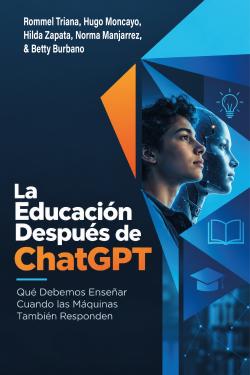
La Educación Después de ChatGPT examina la transformación del aprendizaje ante sistemas de inteligencia artificial capaces de producir respuestas, argumentos y contenidos con creciente sofisticación. La obra replantea el sentido de enseñar cuando recordar información deja de constituir la principal evidencia de dominio intelectual. Desde una perspectiva académica e interdisciplinaria, analiza la formación del pensamiento crítico, la metacognición, el razonamiento causal, la creatividad y el juicio humano como capacidades indispensables para convivir con tecnologías generativas. También estudia la reconfiguración del trabajo docente, el diseño de experiencias intelectuales y la evaluación centrada en procesos de razonamiento, autoría y transferencia del conocimiento. La discusión aborda la alfabetización algorítmica, la ética, la autonomía intelectual y las desigualdades asociadas al acceso diferencial a sistemas inteligentes. Frente a una cultura donde obtener respuestas resulta inmediato, el libro desplaza la atención hacia la calidad de las preguntas, la verificación de evidencias y la responsabilidad de decidir. Su propuesta concibe la educación como espacio para preservar la agencia humana mientras amplía las posibilidades de colaboración entre personas y máquinas. Dirigido a docentes, investigadores, responsables educativos y estudiantes, ofrece un marco conceptual para reconsiderar qué merece aprenderse, evaluarse y cultivarse en sociedades atravesadas por inteligencia artificial responsablemente hoy.
Ali, K., Barhom, N., Tamimi, F., & Duggal, M. (2024). ChatGPT—A double-edged sword for healthcare education? Implications for assessments of dental students. European Journal of Dental Education, 28, 206–211. https://doi.org/10.1111/eje.12937
Ardisana, E. F. H., & Millet Gaínza, B. (2025). Inteligencia artificial (ChatGPT) en la educación universitaria: Realidad y consideraciones éticas. Chakiñan, Revista de Ciencias Sociales y Humanidades, 25. https://doi.org/10.37135/chk.002.25.13
Baek, C., Tate, T., & Warschauer, M. (2024). “ChatGPT seems too good to be true”: College students’ use and perceptions of generative AI. Computers and Education: Artificial Intelligence, 7, 100294. https://doi.org/10.1016/j.caeai.2024.100294
Belényesi, E., & Győrfyné Kukoda, A. (2026). Teaching decision-making in public administration using AI: A comparative study of student and ChatGPT approaches. Teaching Public Administration. https://doi.org/10.1177/01447394261473655
Bin-Nashwan, S. A., Sadallah, M., & Bouteraa, M. (2023). Use of ChatGPT in academia: Academic integrity hangs in the balance. Technology in Society, 75, 102370. https://doi.org/10.1016/j.techsoc.2023.102370
Cooper, G. (2023). Examining science education in ChatGPT: An exploratory study of generative artificial intelligence. Journal of Science Education and Technology, 32, 444–452. https://doi.org/10.1007/s10956-023-10039-y
Dahri, N. A., Yahaya, N., & Al-Rahmi, W. M. (2024). Extended TAM based acceptance of AI-powered ChatGPT for supporting metacognitive self-regulated learning in education: A mixed-methods study. Heliyon, 10(8), e29317. https://doi.org/10.1016/j.heliyon.2024.e29317
Deng, R., Jiang, M., Yu, X., Lu, Y., & Liu, S. (2025). Does ChatGPT enhance student learning? A systematic review and meta-analysis of experimental studies. Computers & Education, 227, 105224. https://doi.org/10.1016/j.compedu.2024.105224
Ding, L., Li, T., Jiang, S., & Gapud, A. (2023). Students’ perceptions of using ChatGPT in a physics class as a virtual tutor. International Journal of Educational Technology in Higher Education, 20, 63. https://doi.org/10.1186/s41239-023-00434-1
Eke, D. O. (2023). ChatGPT and the rise of generative AI: Threat to academic integrity? Journal of Responsible Technology, 13, 100060. https://doi.org/10.1016/j.jrt.2023.100060
Essel, H. B., Vlachopoulos, D., Essuman, A. B., & Amankwa, J. O. (2024). ChatGPT effects on cognitive skills of undergraduate students: Receiving instant responses from AI-based conversational large language models (LLMs). Computers and Education: Artificial Intelligence, 6, 100198. https://doi.org/10.1016/j.caeai.2023.100198
Fernández Manjón, B. (2024). La evaluación educativa en la era de la inteligencia artificial. Padres y Maestros / Journal of Parents and Teachers, 398, 33–40. https://doi.org/10.14422/pym.i398.y2024.005
Fischer, I., Sweeney, S., Lucas, M., & Gupta, N. (2024). Making sense of generative AI for assessments: Contrasting student claims and assessor evaluations. The International Journal of Management Education, 22(3), 101081. https://doi.org/10.1016/j.ijme.2024.101081
Fleckenstein, J., Meyer, J., Jansen, T., Keller, S. D., Köller, O., & Möller, J. (2024). Do teachers spot AI? Evaluating the detectability of AI-generated texts among student essays. Computers and Education: Artificial Intelligence, 6, 100209. https://doi.org/10.1016/j.caeai.2024.100209
Franzoni Velázquez, A. L., Huerta, E., & Jensen, S. (2024). Retracting ChatGPT: Completeness and relevance of academic references. Discover Education, 3, 226. https://doi.org/10.1007/s44217-024-00333-1
Guo, K. (2024). EvaluMate: Using AI to support students’ feedback provision in peer assessment for writing. Assessing Writing, 61, 100864. https://doi.org/10.1016/j.asw.2024.100864
Habib, S., Vogel, T., Anli, X., & Thorne, E. (2024). How does generative artificial intelligence impact student creativity? Journal of Creativity, 34(1), 100072. https://doi.org/10.1016/j.yjoc.2023.100072
Holmes, W., Porayska-Pomsta, K., Holstein, K., Sutherland, E., Baker, T., Buckingham Shum, S., Santos, O. C., Rodrigo, M. T., Cukurova, M., Bittencourt, I. I., & Koedinger, K. R. (2022). Ethics of AI in education: Towards a community-wide framework. International Journal of Artificial Intelligence in Education, 32, 504–526. https://doi.org/10.1007/s40593-021-00239-1
Hornberger, M., Bewersdorff, A., & Nerdel, C. (2023). What do university students know about artificial intelligence? Development and validation of an AI literacy test. Computers and Education: Artificial Intelligence, 5, 100165. https://doi.org/10.1016/j.caeai.2023.100165
Jo, H. (2024). From concerns to benefits: A comprehensive study of ChatGPT usage in education. International Journal of Educational Technology in Higher Education, 21, 35. https://doi.org/10.1186/s41239-024-00471-4
Kartal, G. (2024). The influence of ChatGPT on thinking skills and creativity of EFL student teachers: A narrative inquiry. Journal of Education for Teaching, 50(4), 627–642. https://doi.org/10.1080/02607476.2024.2326502
Kavadella, A., Dias da Silva, M. A., Kaklamanos, E. G., Stamatopoulos, V., & Giannakopoulos, K. (2024). Evaluation of ChatGPT’s real-life implementation in undergraduate dental education: Mixed methods study. JMIR Medical Education, 10, e51344. https://doi.org/10.2196/51344
Korucu Kis, S. (2024). Zone of proximal creativity: An empirical study on EFL teachers’ use of ChatGPT for enhanced practice. Thinking Skills and Creativity, 54, 101639. https://doi.org/10.1016/j.tsc.2024.101639
Kosar, T., Ostojić, D., Liu, Y. D., & Mernik, M. (2024). Computer science education in ChatGPT era: Experiences from an experiment in a programming course for novice programmers. Mathematics, 12(5), 629. https://doi.org/10.3390/math12050629
Lee, D., Arnold, M., Srivastava, A., Plastow, K., Strelan, P., Ploeckl, F., Lekkas, D., & Palmer, E. (2024). The impact of generative AI on higher education learning and teaching: A study of educators’ perspectives. Computers and Education: Artificial Intelligence, 6, 100221. https://doi.org/10.1016/j.caeai.2024.100221
Lee, V. R., Pope, D., Miles, S., & Zárate, R. C. (2024). Cheating in the age of generative AI: A high school survey study of cheating behaviors before and after the release of ChatGPT. Computers and Education: Artificial Intelligence, 7, 100253. https://doi.org/10.1016/j.caeai.2024.100253
Liang, W., & Wu, Y. (2024). Exploring the use of ChatGPT to foster EFL learners’ critical thinking skills from a post-humanist perspective. Thinking Skills and Creativity, 54, 101645. https://doi.org/10.1016/j.tsc.2024.101645
Lye, C. Y., & Lim, L. (2024). Generative artificial intelligence in tertiary education: Assessment redesign principles and considerations. Education Sciences, 14(6), 569. https://doi.org/10.3390/educsci14060569
Mahapatra, S. (2024). Impact of ChatGPT on ESL students’ academic writing skills: A mixed methods intervention study. Smart Learning Environments, 11, 9. https://doi.org/10.1186/s40561-024-00295-9
Moorhouse, B. L., Wan, Y., Wu, C., Kohnke, L., Ho, T. Y., & Kwong, T. (2024). Developing language teachers’ professional generative AI competence: An intervention study in an initial language teacher education course. System, 125, 103399. https://doi.org/10.1016/j.system.2024.103399
Ng, D. T. K., Leung, J. K. L., Chu, K. W. S., & Qiao, M. S. (2021). AI literacy: Definition, teaching, evaluation and ethical issues. Proceedings of the Association for Information Science and Technology, 58(1), 504–509. https://doi.org/10.1002/pra2.487
Nguyen, A., Ngo, H. N., Hong, Y., Dang, B., & Nguyen, B.-P. T. (2023). Ethical principles for artificial intelligence in education. Education and Information Technologies, 28, 4221–4241. https://doi.org/10.1007/s10639-022-11316-w
Pardos, Z. A., & Bhandari, S. (2024). ChatGPT-generated help produces learning gains equivalent to human tutor-authored help on mathematics skills. PLOS ONE, 19(5), e0304013. https://doi.org/10.1371/journal.pone.0304013
Saravia-Rojas, M. Á., Camarena-Fonseca, A. R., León-Manco, R., & Geng-Vivanco, R. (2024). Artificial intelligence: ChatGPT as a disruptive didactic strategy in dental education. Journal of Dental Education, 88(6), 872–876. https://doi.org/10.1002/jdd.13485
Segarra Ciprés, M., Grangel Seguer, R., & Belmonte Fernández, Ó. (2024). ChatGPT como herramienta de apoyo al aprendizaje en la educación superior: Una experiencia docente. Revista Tecnología, Ciencia y Educación, 28, 7–44. https://doi.org/10.51302/tce.2024.19083
Steiss, J., Tate, T., Graham, S., Cruz, J., Hebert, M., Wang, J., Moon, Y., Tseng, W., Warschauer, M., & Olson, C. B. (2024). Comparing the quality of human and ChatGPT feedback of students’ writing. Learning and Instruction, 91, 101894. https://doi.org/10.1016/j.learninstruc.2024.101894
Strzelecki, A. (2024). Students’ acceptance of ChatGPT in higher education: An extended unified theory of acceptance and use of technology. Innovative Higher Education, 49, 223–245. https://doi.org/10.1007/s10755-023-09686-1
Sun, D., Boudouaia, A., Zhu, C., & Li, Y. (2024). Would ChatGPT-facilitated programming mode impact college students’ programming behaviors, performances, and perceptions? An empirical study. International Journal of Educational Technology in Higher Education, 21, 14. https://doi.org/10.1186/s41239-024-00446-5
Svendsen, K., Askar, M., Umer, D., & Halvorsen, K. H. (2024). Short-term learning effect of ChatGPT on pharmacy students’ learning. Exploratory Research in Clinical and Social Pharmacy, 15, 100478. https://doi.org/10.1016/j.rcsop.2024.100478
Tang, T., Sha, J., Zhao, Y., Wang, S., Wang, Z., & Shen, S. (2024). Unveiling the efficacy of ChatGPT in evaluating critical thinking skills through peer feedback analysis: Leveraging existing classification criteria. Thinking Skills and Creativity, 53, 101607. https://doi.org/10.1016/j.tsc.2024.101607
Toma, R. B., & Yánez-Pérez, I. (2024). Effects of ChatGPT use on undergraduate students’ creativity: A threat to creative thinking? Discover Artificial Intelligence, 4, 74. https://doi.org/10.1007/s44163-024-00172-x
Tzirides, A. O., Zapata, G., Kastania, N. P., Saini, A. K., Castro, V., Ismael, S. A., You, Y., Santos, T. A. D., Searsmith, D., O’Brien, C., Cope, B., & Kalantzis, M. (2024). Combining human and artificial intelligence for enhanced AI literacy in higher education. Computers and Education Open, 6, 100184. https://doi.org/10.1016/j.caeo.2024.100184
Urban, M., Děchtěrenko, F., Lukavský, J., Hrabalová, V., Svacha, F., Brom, C., & Urban, K. (2024). ChatGPT improves creative problem-solving performance in university students: An experimental study. Computers & Education, 215, 105031. https://doi.org/10.1016/j.compedu.2024.105031
Walters, W. H., & Wilder, E. I. (2023). Fabrication and errors in the bibliographic citations generated by ChatGPT. Scientific Reports, 13, 14045. https://doi.org/10.1038/s41598-023-41032-5
Waltzer, T., Cox, R. L., & Heyman, G. D. (2023). Testing the ability of teachers and students to differentiate between essays generated by ChatGPT and high school students. Human Behavior and Emerging Technologies, 2023, 1923981. https://doi.org/10.1155/2023/1923981
Woo, D. J., Wang, D., Guo, K., & Susanto, H. (2024). Teaching EFL students to write with ChatGPT: Students’ motivation to learn, cognitive load, and satisfaction with the learning process. Education and Information Technologies, 29, 24963–24990. https://doi.org/10.1007/s10639-024-12819-4
Yang, A. C. M., Lin, J.-Y., Lin, C.-Y., & Ogata, H. (2024). Enhancing Python learning with PyTutor: Efficacy of a ChatGPT-based intelligent tutoring system in programming education. Computers and Education: Artificial Intelligence, 7, 100309. https://doi.org/10.1016/j.caeai.2024.100309
Zhang, C. X., Rice, R. E., & Wang, L. H. (2026). College students’ literacy, ChatGPT activities, educational outcomes, and trust from a digital divide perspective. New Media & Society, 28(2), 673–695. https://doi.org/10.1177/14614448241301741
Vol. 3 Núm. 3 (2026)
Vol. 3 Núm. 2 (2026)








 10 de agosto 232 entre Almendros y Mangos, Cdla. Alborada sector 2, Machala, Ecuador
 editorialsaga.ec@gmail.com
 +593962679148