Vol. 3 Núm. 3 (2026) 
Vol. 3 Núm. 2 (2026) 

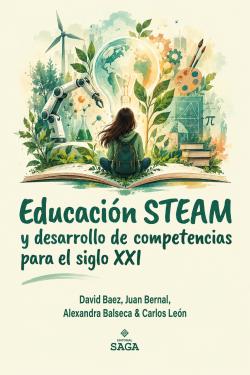
Educación STEAM y desarrollo de competencias para el siglo XXI presenta una visión académica de la integración entre ciencia, tecnología, ingeniería, artes y matemáticas como vía para renovar los procesos formativos y fortalecer capacidades vinculadas con las demandas educativas contemporáneas. La obra analiza principios pedagógicos que articulan saberes disciplinares mediante experiencias de aprendizaje activo. Examina el pensamiento crítico, la creatividad, la comunicación y la colaboración desde una perspectiva interdisciplinaria orientada a la resolución de problemas complejos. También aborda el pensamiento computacional, la alfabetización científica y la autonomía intelectual como componentes de una formación pertinente. Diversas metodologías organizan la propuesta pedagógica. El aprendizaje basado en proyectos, el Design Thinking, la cultura maker y la gamificación permiten vincular investigación con creación. A ello se incorporan inteligencia artificial generativa, robótica educativa, realidad extendida, internet de las cosas y analítica del aprendizaje. La reflexión pedagógica considera además ciudadanía digital, ética algorítmica y responsabilidad tecnológica. El libro examina criterios para diseñar currículos interdisciplinarios, secuencias didácticas y sistemas de evaluación auténtica mediante rúbricas, portafolios y evidencias multimodales. Su planteamiento favorece la formación docente, el liderazgo pedagógico y la investigación educativa orientada a consolidar prácticas STEAM capaces de transformar el aprendizaje con pertinencia social y proyección sostenible.
Abichandani, P., Sivakumar, V., Lobo, D., Iaboni, C., & Shekhar, P. (2022). Internet-of-Things curriculum, pedagogy, and assessment for STEM education: A review of literature. IEEE Access, 10, 38351–38369. https://doi.org/10.1109/ACCESS.2022.3164709
Ahmed, Z., Shanto, S. S., & Jony, A. I. (2024). Potentiality of generative AI tools in higher education: Evaluating ChatGPT's viability as a teaching assistant for introductory programming courses. STEM Education, 4(3), 165–182. https://doi.org/10.3934/steme.2024011
Aler Tubella, A., Mora-Cantallops, M., & Nieves, J. C. (2024). How to teach responsible AI in higher education: Challenges and opportunities. Ethics and Information Technology, 26, 3. https://doi.org/10.1007/s10676-023-09733-7
Álvarez Ariza, J., & Olatunde-Aiyedun, T. G. (2024). A systematic literature review on STEAM pre- and in-service teacher education for sustainability: Are teachers ready? Eurasia Journal of Mathematics, Science and Technology Education, 20(9), em2498. https://doi.org/10.29333/ejmste/14982
Amanova, A. K., Butabayeva, L. A., Abayeva, G. A., Umirbekova, A. N., Abildina, S. K., & Makhmetova, A. A. (2025). A systematic review of the implementation of STEAM education in schools. Eurasia Journal of Mathematics, Science and Technology Education. https://doi.org/10.29333/ejmste/15894
Apkarian, N., Henderson, C., Stains, M., Raker, J., Johnson, E., & Dancy, M. (2021). What really impacts the use of active learning in undergraduate STEM education? Results from a national survey of chemistry, mathematics, and physics instructors. PLOS ONE, 16(2), e0247544. https://doi.org/10.1371/journal.pone.0247544
Arpaci, I., Dogru, M. S., Kanj, H., Ali, N., & Bahari, M. (2023). An experimental study on the implementation of a STEAM-based learning module in science education. Sustainability, 15(8), 6807. https://doi.org/10.3390/su15086807
Bautista, A. (2021). STEAM education: Contributing evidence of validity and effectiveness. Journal for the Study of Education and Development, 44(4), 755–768. https://doi.org/10.1080/02103702.2021.1926678
Casado Fernández, R., & Checa Romero, M. (2023). Creativity, critical thinking and teamwork in primary education: An interdisciplinary approach through STEAM projects. Revista Complutense de Educación, 34(3), 629–640. https://doi.org/10.5209/rced.79861
Chang, H.-Y., Binali, T., Liang, J.-C., Chiou, G.-L., Cheng, K.-H., Lee, S. W.-Y., & Tsai, C.-C. (2022). Ten years of augmented reality in education: A meta-analysis of (quasi-) experimental studies to investigate the impact. Computers & Education, 191, 104641. https://doi.org/10.1016/j.compedu.2022.104641
Cheng, L., Wang, X., & Ritzhaupt, A. D. (2023). The effects of computational thinking integration in STEM on students’ learning performance in K-12 education: A meta-analysis. Journal of Educational Computing Research, 61(2). https://doi.org/10.1177/07356331221114183
Ching, Y.-H., & Hsu, Y.-C. (2023). Educational robotics for developing computational thinking in young learners: A systematic review. TechTrends. https://doi.org/10.1007/s11528-023-00841-1
Cromley, J. G., Chen, R., & Lawrence, L. E. M. (2023). Meta-analysis of STEM learning using virtual reality: Benefits across the board. Journal of Science Education and Technology, 32, 355–364. https://doi.org/10.1007/s10956-023-10032-5
Darmawansah, D., Hwang, G.-J., & Chen, M.-R. A. (2023). Trends and research foci of robotics-based STEM education: A systematic review from diverse angles based on the technology-based learning model. International Journal of STEM Education, 10, 12. https://doi.org/10.1186/s40594-023-00400-3
Deng, R., Jiang, M., Yu, X., Lu, Y., & Liu, S. (2025). Does ChatGPT enhance student learning? A systematic review and meta-analysis of experimental studies. Computers & Education, 227, 105224. https://doi.org/10.1016/j.compedu.2024.105224
Diego-Mantecon, J.-M., Prodromou, T., Lavicza, Z., & Blanco, T. F. (2021). An attempt to evaluate STEAM project-based instruction from a school mathematics perspective. ZDM–Mathematics Education, 53(5), 1137–1148. https://doi.org/10.1007/s11858-021-01303-9
El Nagdi, M. A., & Roehrig, G. H. (2022). Reality vs. expectations of assessment in STEM education: An exploratory case study of STEM schools in Egypt. Education Sciences, 12(11), 762. https://doi.org/10.3390/educsci12110762
García Fuentes, O., Raposo Rivas, M., & Martínez Figueira, M. E. (2023). STEAM education: Review of literature. Revista Complutense de Educación, 34(1), 191–202. https://doi.org/10.5209/rced.77261
Grimm, A., Steegh, A., Çolakoğlu, J., Kubsch, M., & Neumann, K. (2023). Positioning responsible learning analytics in the context of STEM identities of under-served students. Frontiers in Education, 7, 1082748. https://doi.org/10.3389/feduc.2022.1082748
Guaman-Quintanilla, S., Chiluiza, K., Bravo Matamoros, A., Everaert, P., & Valcke, M. (2022). ¿Cuál es el estado del arte de la aplicación de Design Thinking en la educación superior? Una revisión de alcance de la literatura. Aula Abierta, 51(4), 319–328. https://doi.org/10.17811/rifie.51.4.2022.319-328
Hariyono, E., Suprapto, N., Zakhiyah, I., & Ismail, M. H. (2023). Development of dye-sensitized solar cells STEAM learning prototype for supporting education for sustainable development. EUREKA: Physics and Engineering. https://doi.org/10.21303/2461-4262.2023.002928
Hsiao, H.-S., Chen, J.-C., Chen, J.-H., Zeng, Y.-T., & Chung, G.-H. (2022). An assessment of junior high school students’ knowledge, creativity, and hands-on performance using PBL via cognitive–affective interaction model to achieve STEAM. Sustainability, 14(9), 5582. https://doi.org/10.3390/su14095582
Huang, B., Jong, M. S.-Y., Tu, Y.-F., Hwang, G.-J., Chai, C. S., & Jiang, M. Y.-C. (2022). Trends and exemplary practices of STEM teacher professional development programs in K-12 contexts: A systematic review of empirical studies. Computers & Education, 189, 104577. https://doi.org/10.1016/j.compedu.2022.104577
Jeong, H.-M., Kwon, H., & Kim, S.-H. (2023). A meta-analytic approach for examining the effects of STEAM education programs in South Korea. Innovation and Education, 5(1), 81–97. https://doi.org/10.55396/ined.22.0006
Khor, E. T., & K, M. (2024). A systematic review of the role of learning analytics in supporting personalized learning. Education Sciences, 14(1), 51. https://doi.org/10.3390/educsci14010051
Lai, X., & Wong, G. K.-W. (2022). Collaborative versus individual problem solving in computational thinking through programming: A meta-analysis. British Journal of Educational Technology, 53, 150–170. https://doi.org/10.1111/bjet.13157
Leavy, A., Dick, L., Meletiou-Mavrotheris, M., Paparistodemou, E., & Stylianou, E. (2023). The prevalence and use of emerging technologies in STEAM education: A systematic review of the literature. Journal of Computer Assisted Learning, 39(4), 1061–1082. https://doi.org/10.1111/jcal.12806
Li, C., Herbert, N., Yeom, S., & Montgomery, J. (2022). Retention factors in STEM education identified using learning analytics: A systematic review. Education Sciences, 12(11), 781. https://doi.org/10.3390/educsci12110781
Li, T., & Zhan, Z. (2022). A systematic review on design thinking integrated learning in K-12 education. Applied Sciences, 12(16), 8077. https://doi.org/10.3390/app12168077
Liston, M., Morrin, A. M., Furlong, T., & Griffin, L. (2022). Integrating data science and the Internet of Things into science, technology, engineering, arts, and mathematics education through the use of new and emerging technologies. Frontiers in Education, 7, 757866. https://doi.org/10.3389/feduc.2022.757866
Liu, C.-Y., & Li, W. (2023). Collaborative programming based on social shared regulation: An approach to improving students’ programming achievements and group metacognition. Journal of Computer Assisted Learning. https://doi.org/10.1111/jcal.12828
Lu, S.-Y., Lo, C.-C., & Syu, J.-Y. (2022). Project-based learning oriented STEAM: The case of micro–bit paper-cutting lamp. International Journal of Technology and Design Education, 32, 2553–2575. https://doi.org/10.1007/s10798-021-09714-1
Ng, D. T. K., Tan, C. W., & Leung, J. K. L. (2024). Empowering student self-regulated learning and science education through ChatGPT: A pioneering pilot study. British Journal of Educational Technology, 55, 1328–1353. https://doi.org/10.1111/bjet.13454
Nguyen, K. A., Borrego, M., Finelli, C. J., DeMonbrun, M., Crockett, C., Tharayil, S., Shekhar, P., Waters, C., & Rosenberg, R. (2021). Instructor strategies to aid implementation of active learning: A systematic literature review. International Journal of STEM Education, 8, 9. https://doi.org/10.1186/s40594-021-00270-7
Ogegbo, A. A., & Ramnarain, U. (2022). A systematic review of computational thinking in science classrooms. Studies in Science Education, 58(2), 203–230. https://doi.org/10.1080/03057267.2021.1963580
Ouyang, F., & Xu, W. (2024). The effects of educational robotics in STEM education: A multilevel meta-analysis. International Journal of STEM Education, 11, 7. https://doi.org/10.1186/s40594-024-00469-4
Öztürk, A., & Korkut, F. (2023). Design thinking customized to support STEM teachers: Co-developing and implementing STEM activities for fifth graders in Turkey. International Journal of Technology and Design Education, 33, 1409–1447. https://doi.org/10.1007/s10798-022-09790-x
Park, W., & Cho, H. (2022). The interaction of history and STEM learning goals in teacher-developed curriculum materials: Opportunities and challenges for STEAM education. Asia Pacific Education Review, 23, 457–474. https://doi.org/10.1007/s12564-022-09741-0
Ramli, F. N. A., & Mohamad Arsad, N. (2023). STEM teacher digital literacy: Relationship between digital literacy and technology integration in teaching and learning post Covid-19. Journal of Nusantara Studies, 8(2), 316–333. https://doi.org/10.24200/jonus.vol8iss2pp316-333
Rendón Gil, J. G. R., & Angulo Armenta, J. (2022). Metaanálisis sobre ciudadanía digital en Iberoamérica: Énfasis en educación. Edutec. Revista Electrónica de Tecnología Educativa, 82, 91–103. https://doi.org/10.21556/edutec.2022.82.2593
Rodrigues-Silva, J., & Alsina, Á. (2023). STEM/STEAM in early childhood education for sustainability (ECEfS): A systematic review. Sustainability, 15(4), 3721. https://doi.org/10.3390/su15043721
Santhosh, M., Farooqi, H., Ammar, M., Siby, N., Bhadra, J., Al-Thani, N. J., Sellami, A., Fatima, N., & Ahmad, Z. (2023). A meta-analysis to gauge the effectiveness of STEM informal project-based learning: Investigating the potential moderator variables. Journal of Science Education and Technology, 32, 671–685. https://doi.org/10.1007/s10956-023-10063-y
Sanz-Camarero, R., Ortiz-Revilla, J., & Greca, I. M. (2023). The impact of integrated STEAM education on arts education: A systematic review. Education Sciences, 13(11), 1139. https://doi.org/10.3390/educsci13111139
Satrústegui Moreno, A., & Mateo González, E. (2023). Mejora del pensamiento crítico en alumnos de ESO a través del aprendizaje basado en problemas en un entorno STEAM. Revista de Estilos de Aprendizaje, 16(32), 19–32. https://doi.org/10.55777/rea.v16i32.5990
Sun, L., Hu, L., & Zhou, D. (2021). Which way of design programming activities is more effective to promote K-12 students’ computational thinking skills? A meta-analysis. Journal of Computer Assisted Learning, 37, 1048–1062. https://doi.org/10.1111/jcal.12545
Surahman, E., & Wang, T.-H. (2023). In-service STEM teachers professional development programmes: A systematic literature review 2018–2022. Teaching and Teacher Education, 135, 104326. https://doi.org/10.1016/j.tate.2023.104326
Tadlaoui-Brahmi, A., Çuko, K., & Alvarez, L. (2022). Digital citizenship in primary education: A systematic literature review describing how it is implemented. Social Sciences & Humanities Open, 6(1), 100348. https://doi.org/10.1016/j.ssaho.2022.100348
Tasquier, G., Knain, E., & Jornet, A. (2022). Scientific literacies for change making: Equipping the young to tackle current societal challenges. Frontiers in Education, 7, 689329. https://doi.org/10.3389/feduc.2022.689329
Usher, M., & Barak, M. (2024). Unpacking the role of AI ethics online education for science and engineering students. International Journal of STEM Education, 11, 35. https://doi.org/10.1186/s40594-024-00493-4
Valeri, F., Nilsson, P., & Cederqvist, A.-M. (2025). Exploring students’ experience of ChatGPT in STEM education. Computers and Education: Artificial Intelligence, 8, 100360. https://doi.org/10.1016/j.caeai.2024.100360
Videla, R., Aguayo, C., & Veloz, T. (2021). From STEM to STEAM: An enactive and ecological continuum. Frontiers in Education, 6, 709560. https://doi.org/10.3389/feduc.2021.709560
Wang, H.-H., Hong, Z.-R., & She, H.-C. (2022). The role of structured inquiry, open inquiry, and epistemological beliefs in developing secondary students’ scientific and mathematical literacies. International Journal of STEM Education, 9, 14. https://doi.org/10.1186/s40594-022-00329-z
Wang, K. D., Burkholder, E., Wieman, C., Salehi, S., & Haber, N. (2024). Examining the potential and pitfalls of ChatGPT in science and engineering problem-solving. Frontiers in Education, 8, 1330486. https://doi.org/10.3389/feduc.2023.1330486
Wang, L.-H., Chen, B., Hwang, G.-J., Guan, J.-Q., & Wang, Y.-Q. (2022). Effects of digital game-based STEM education on students’ learning achievement: A meta-analysis. International Journal of STEM Education, 9, 26. https://doi.org/10.1186/s40594-022-00344-0
Wannapiroon, N., & Pimdee, P. (2022). Thai undergraduate science, technology, engineering, arts, and math (STEAM) creative thinking and innovation skill development: A conceptual model using a digital virtual classroom learning environment. Education and Information Technologies, 27(4), 5689–5716. https://doi.org/10.1007/s10639-021-10849-w
Widana, I. W., Sopandi, A. T., & Suwardika, G. (2021). Development of an authentic assessment model in mathematics learning: A science, technology, engineering, and mathematics (STEM) approach. Indonesian Research Journal in Education, 5(1). https://doi.org/10.22437/irje.v5i1.12992
Wiegand, S., & Borromeo Ferri, R. (2023). Promoting pre-service teachers’ professionalism in STEAM education and education for sustainable development through mathematical modelling activities. ZDM–Mathematics Education, 55, 1269–1282. https://doi.org/10.1007/s11858-023-01500-8
Xu, W., & Ouyang, F. (2022). The application of AI technologies in STEM education: A systematic review from 2011 to 2021. International Journal of STEM Education, 9, 59. https://doi.org/10.1186/s40594-022-00377-5
Zhan, Z., Yao, X., & Li, T. (2022). Effects of association interventions on students’ creative thinking, aptitude, empathy, and design scheme in a STEAM course: Considering remote and close association. International Journal of Technology and Design Education. https://doi.org/10.1007/s10798-022-09801-x
Zhang, L., & Ma, Y. (2023). A study of the impact of project-based learning on student learning effects: A meta-analysis study. Frontiers in Psychology, 14, 1202728. https://doi.org/10.3389/fpsyg.2023.1202728
Zhang, Q., & Yu, Z. (2022). Meta-analysis on investigating and comparing the effects on learning achievement and motivation for gamification and game-based learning. Education Research International, 2022, 1519880. https://doi.org/10.1155/2022/1519880
Zhou, X., Shu, L., Xu, Z., & Padrón, Y. (2023). The effect of professional development on in-service STEM teachers’ self-efficacy: A meta-analysis of experimental studies. International Journal of STEM Education, 10, 37. https://doi.org/10.1186/s40594-023-00422-x
Vol. 3 Núm. 3 (2026)
Vol. 3 Núm. 2 (2026)








 10 de agosto 232 entre Almendros y Mangos, Cdla. Alborada sector 2, Machala, Ecuador
 editorialsaga.ec@gmail.com
 +593962679148