Vol. 3 Núm. 3 (2026) 
Vol. 3 Núm. 2 (2026) 

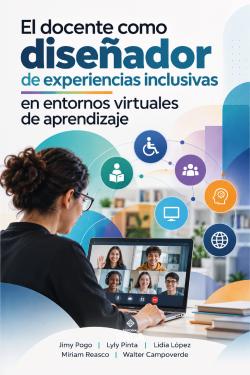
Este libro examina la transformación de la práctica educativa desde una perspectiva pedagógica centrada en la diversidad humana y la participación equitativa. La obra analiza la función del profesorado como creador de ambientes digitales accesibles mediante decisiones didácticas sustentadas en principios de justicia educativa y reconocimiento de las diferencias individuales. Su desarrollo conceptual articula el Diseño Universal para el Aprendizaje con arquitecturas pedagógicas flexibles que favorecen trayectorias formativas diferenciadas. Asimismo, aborda las mediaciones tecnopedagógicas que fortalecen la interacción y la construcción colaborativa del conocimiento. La inteligencia artificial adquiere relevancia como recurso para diversificar experiencias educativas bajo criterios éticos de transparencia y responsabilidad profesional. El texto profundiza en la accesibilidad digital y en los procesos de evaluación auténtica mediante estrategias que reconocen distintas formas de expresión del aprendizaje. Desde una perspectiva investigativa, incorpora el codiseño participativo y la experimentación pedagógica como prácticas de transformación institucional. Cada capítulo establece relaciones entre reflexión teórica y aplicación educativa para fortalecer la capacidad docente de identificar barreras y diseñar respuestas pertinentes. La propuesta contribuye al debate académico sobre inclusión digital mediante una concepción del diseño pedagógico comprometida con la autonomía estudiantil y el derecho a aprender.
Abgaz, Y. (2026). An integrated framework for interactive and inclusive asynchronous online learning at scale: Data literacy in higher education. Education Sciences, 16(4), 639. https://www.mdpi.com/2227-7102/16/4/639
Almaki, S. H., Al Mazrouei, A. K., Mafarja, N., Naseem, W., Sial, M. A., & Naveed, R. T. (2024). Factors influencing inclusive teachers’ acceptance to adopt eLearning platforms in classroom: A case study in Oman. Frontiers in Education. https://doi.org/10.3389/feduc.2024.1477659
Almeqdad, Q. I., Alodat, A. M., Alquraan, M. F., Mohaidat, M. A., & Al-Makhzoomy, A. K. (2023). The effectiveness of universal design for learning: A systematic review of the literature and meta-analysis. Cogent Education. https://doi.org/10.1080/2331186X.2023.2218191
Angeioplastis, A., Konstantakis, M., Aliprantis, J., Ordoumpozanis, K., Varsamis, D., & Tsimpiris, A. (2026). AI for all: Adaptive, accessible, and inclusive learning experiences in the age of intelligent LMSs. Information, 17(2), 216. https://www.mdpi.com/2078-2489/17/2/216
Bray, A., Devitt, A., Banks, J., Sanchez Fuentes, S., Sandoval, M., Riviou, K., Byrne, D., Flood, M., Reale, J., & Terrenzio, S. (2024). What next for Universal Design for Learning? A systematic literature review of technology in UDL implementations at second level. British Journal of Educational Technology. https://doi.org/10.1111/bjet.13328
Caskurlu, S., Castellanos-Reyes, D., Lim, J., & Kozan, K. (2025). The community of inquiry framework and learning analytics: A systematic review of previous research. Computers and Education Open. https://doi.org/10.1016/j.caeo.2025.100289
Castro Castillo, G., Cárdenas-Cobo, J., Tenutto Soldevilla, M., & Vidal-Silva, C. (2024). Analyzing the teaching profile and competency-based training in online education: A case study of Ecuadorian professors. Frontiers in Education, 9, 1397086. https://doi.org/10.3389/feduc.2024.1397086
Chang, C.-C., Yen, W.-H., Liu, S.-C., & Kuo, C.-T. (2026). Learning presence in the revised community of inquiry framework: A systematic review of empirical research (2010–2024). The Internet and Higher Education, 68, 101058. https://doi.org/10.1016/j.iheduc.2025.101058
Chick, J. C., Morello, L., & Vance, J. (2025). Universal design for learning as an equity framework: Addressing educational barriers and enablers for diverse non-traditional learners. Education Sciences, 15(9), 1265. https://doi.org/10.3390/educsci15091265
Hershkovitz, A., Ambrose, G. A., & Soffer, T. (2024). Instructors’ perceptions of the use of learning analytics for data-driven decision making. Education Sciences. https://doi.org/10.3390/educsci14111180
Li, L., Zhang, R., & Piper, A. M. (2023). Predictors of student engagement and perceived learning in emergency online education amidst COVID-19: A community of inquiry perspective. Computers in Human Behavior Reports. https://doi.org/10.1016/j.chbr.2023.100326
Li, Y.-F., Zhang, D., Liu, C.-T., Wang, K., Yan, W., & Dong, X. (2024). Perceptions of UDL teaching practices among university students with disabilities. Education Sciences, 14(5), 501. https://doi.org/10.3390/educsci14050501
Melo-López, V.-A., Basantes-Andrade, A., Gudiño-Mejía, C.-B., & Hernández-Martínez, E. (2025). The impact of artificial intelligence on inclusive education: A systematic review. Education Sciences, 15(5), 539. https://doi.org/10.3390/educsci15050539
Moriña, A., Carballo, R., & Castellano-Beltran, A. (2024). A systematic review of the benefits and challenges of technologies for the learning of university students with disabilities. Journal of Special Education Technology. https://eric.ed.gov/?id=EJ1410471
Osorio, C., Fuster, N., Chen, W., Men, Y., & Juan, A. A. (2024). Enhancing accessibility to analytics courses in higher education through AI, simulation, and e-collaborative tools. Information, 15(8), 430. https://doi.org/10.3390/info15080430
Rosero, X., & Inga, E. (2025). Transforming inclusive education through gamification and active learning strategies. Information, 16(9), 753. https://doi.org/10.3390/info16090753
Sailer, M., Maier, R., Berger, S., Kastorff, T., & Stegmann, K. (2024). Learning activities in technology-enhanced learning: A systematic review of meta-analyses and second-order meta-analysis in higher education. Learning and Individual Differences. https://doi.org/10.1016/j.lindif.2024.102446
Sánchez, A., Ledezma, C., & Font, V. (2025). A proposal of integration of Universal Design for Learning and didactic suitability criteria. Education Sciences, 15(7), 909. https://doi.org/10.3390/educsci15070909
Sánchez Vásquez, F., Pérez-Arriaga, J. C., Contreras Vega, G., Luján-Mora, S., & Otón Tortosa, S. (2022). Towards the implementation process of accessible virtual campuses in higher education institutions in Latin America. Applied Sciences, 12(11), 5470. https://doi.org/10.3390/app12115470
Sharif, H., & Atif, A. (2024). The evolving classroom: How learning analytics is shaping the future of education and feedback mechanisms. Education Sciences, 14(2), 176. https://doi.org/10.3390/educsci14020176
Solano, A., Peláez, C. A., Ospina, J. A., Luna-García, H., Parra, J. A., Ramírez, G. M., Moreira, F., López Sotelo, J. A., & Villalba-Condori, K. O. (2024). Work route for the inclusion of learning analytics in the development of interactive multimedia experiences for elementary education. Applied Sciences, 14(17), 7645. https://doi.org/10.3390/app14177645
Yang, M., Duha, M. S. U., Kirsch, B. A., Glaser, N., Crompton, H., & Luo, T. (2024). Universal design in online education: A systematic review. Distance Education. https://doi.org/10.1080/01587919.2024.2303494
Zabala, S., Galán Hernández, J. J., Garcés Jiménez, A., Gómez Pulido, J. M., Medina, S. E., & Morales Cevallos, M. B. (2026). Conceptual AI-informed institutional learning analytics: Extending the TAM to strengthen inclusive digital justice. Applied Sciences, 16(8), 3737. https://doi.org/10.3390/app16083737
Vol. 3 Núm. 3 (2026)
Vol. 3 Núm. 2 (2026)










 10 de agosto 232 entre Almendros y Mangos, Cdla. Alborada sector 2, Machala, Ecuador
 editorialsaga.ec@gmail.com
 +593962679148
