Vol. 3 Núm. 3 (2026) 
Vol. 3 Núm. 2 (2026) 

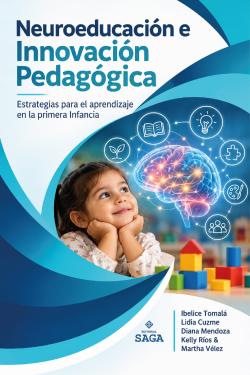
Neuroeducación e Innovación Pedagógica: Estrategias para el aprendizaje en la primera Infancia presenta una visión interdisciplinaria del aprendizaje infantil sustentada en aportes de la neurociencia, la pedagogía y la psicología del desarrollo. La obra analiza la relación entre plasticidad cerebral, atención, memoria, lenguaje y funciones ejecutivas durante los primeros años de vida. También aborda la influencia de las emociones, la motivación y el bienestar en la construcción de aprendizajes significativos. El juego, el movimiento y las experiencias multisensoriales adquieren valor pedagógico como vías para favorecer la curiosidad, la creatividad y la participación infantil. Desde una perspectiva aplicada, el libro articula metodologías activas, proyectos, estaciones de aprendizaje, narrativas pedagógicas, recursos digitales y documentación de procesos para enriquecer la Educación Inicial. La neurodiversidad y el Diseño Universal para el Aprendizaje orientan propuestas destinadas a reconocer ritmos, capacidades e intereses diversos. A lo largo de cinco capítulos, docentes, estudiantes e investigadores encontrarán criterios para interpretar evidencia científica, cuestionar neuromitos y tomar decisiones pedagógicas responsables. La reflexión profesional ocupa un lugar central, vinculando observación, evaluación auténtica y colaboración con las familias para promover experiencias educativas inclusivas, pertinentes y respetuosas del desarrollo integral de cada niño desde una mirada ética y comprometida con la infancia.
Al-walah, M. A., Donnelly, M., & Alhusaini, A. A. (2024). Pre-school-based behaviour change intervention to increase physical activity levels amongst young children: A feasibility cluster randomised controlled trial. Frontiers in Public Health, 12, 1379582. https://doi.org/10.3389/fpubh.2024.1379582
Alotaibi, M. S. (2024). Game-based learning in early childhood education: A systematic review and meta-analysis. Frontiers in Psychology, 15, 1307881. https://doi.org/10.3389/fpsyg.2024.1307881
Aoyama, S. (2024). Effects of soccer instruction on the executive functions and agility of children in early childhood. PLOS ONE, 19(10), e0312265. https://doi.org/10.1371/journal.pone.0312265
Bingham, G. E., & Gerde, H. K. (2023). Early childhood teachers’ writing beliefs and practices. Frontiers in Psychology, 14, 1236652. https://doi.org/10.3389/fpsyg.2023.1236652
Chen, J. J., & Rivera-Vernazza, D. E. (2022). Communicating digitally: Building preschool teacher-parent partnerships via digital technologies during COVID-19. Early Childhood Education Journal. https://doi.org/10.1007/s10643-022-01366-7
Deniz, E., Francis, G., Torgerson, C., & Toseeb, U. (2024). Parent-mediated play-based interventions to improve social communication and language skills of preschool autistic children: A systematic review and meta-analysis. Review Journal of Autism and Developmental Disorders. https://doi.org/10.1007/s40489-024-00463-0
Deodhar, A. V., & Bertenthal, B. I. (2023). How attention factors into executive function in preschool children. Frontiers in Psychology, 14, 1146101. https://doi.org/10.3389/fpsyg.2023.1146101
Ferrero, M., Vadillo, M. A., & León, S. P. (2021). Is project-based learning effective among kindergarten and elementary students? A systematic review. PLOS ONE, 16(4), e0249627. https://doi.org/10.1371/journal.pone.0249627
Gerosa, A., Koleszar, V., Tejera, G., Gómez-Sena, L., & Carboni, A. (2022). Educational robotics intervention to foster computational thinking in preschoolers: Effects of children’s task engagement. Frontiers in Psychology, 13, 904761. https://doi.org/10.3389/fpsyg.2022.904761
Keengwe, G., & Onchwari, A. (2022). Assessment of parent–teacher relationships in early childhood education programs during the COVID-19 pandemic. Early Childhood Education Journal. https://doi.org/10.1007/s10643-022-01431-1
Lau, E. Y. H., Wu, X., Siu, C. T. S., & Williams, K. E. (2025). Examining the effectiveness of a video-based parent–child program on executive functions for children 5 to 6 years old: A randomized controlled trial. Child Development, 96(2), 781–796. https://doi.org/10.1111/cdev.14208
Magro, S. W., Nivison, M. D., & Englund, M. M. (2023). The quality of early caregiving and teacher-student relationships in grade school independently predict adolescent academic achievement. International Journal of Behavioral Development, 47(2), 158–168. https://doi.org/10.1177/01650254221137511
Mao, F., Huang, F., Zhao, S., & Fang, Q. (2024). Effects of cognitively engaging physical activity interventions on executive function in children and adolescents: A systematic review and meta-analysis. Frontiers in Psychology, 15, 1454447. https://doi.org/10.3389/fpsyg.2024.1454447
Muñoz-Ortiz, W. W., García-Mera, G. M., Esteves-Fajardo, Z. I., & Peñalver-Higuera, M. J. (2023). El Diseño Universal de Aprendizaje: Un enfoque para la educación inclusiva. Episteme Koinonía, 6(12). https://doi.org/10.35381/e.k.v6i12.2550
Novak-Geiger, V. (2023). Prevalence of neuromyths among psychology students: Small differences to pre-service teachers. Frontiers in Psychology, 14, 1139911. https://doi.org/10.3389/fpsyg.2023.1139911
Olive, L. S., Telford, R. M., Westrupp, E., & Telford, R. D. (2024). Physical activity intervention improves executive function and language development during early childhood: The active early learning cluster randomized controlled trial. Child Development, 95(2), 544–558. https://doi.org/10.1111/cdev.14014
Peña, M., Vásquez-Venegas, C., & Cortés, P. (2024). A brief tablet-based intervention benefits linguistic and communicative abilities in toddlers and preschoolers. npj Science of Learning, 9, 38. https://doi.org/10.1038/s41539-024-00249-3
Peters, V., Bissonnette, J., Nadeau, D., & Gauthier-Légaré, A. (2024). The impact of musicking on emotion regulation: A systematic review and meta-analysis. Psychology of Music, 52(5), 548–568. https://doi.org/10.1177/03057356231212362
Schoppmann, J., Severin, F., & Schneider, S. (2023). The effect of picture book reading on young children’s use of an emotion regulation strategy. PLOS ONE, 18(8), e0289403. https://doi.org/10.1371/journal.pone.0289403
Şimşek, E. E. (2024). The effect of augmented reality storybooks on the story comprehension and retelling of preschool children. Frontiers in Psychology, 15, 1459264. https://doi.org/10.3389/fpsyg.2024.1459264
Skene, K., O’Farrelly, C. M., Byrne, E. M., Kirby, N., Stevens, E. C., & Ramchandani, P. G. (2022). Can guidance during play enhance children’s learning and development in educational contexts? A systematic review and meta-analysis. Child Development, 93(4), 1162–1180. https://doi.org/10.1111/cdev.13730
Smith-Nielsen, J., Stuart, A. C., & Wendelboe, K. I. (2024). The significance of parental mentalizing for four-year-old children’s solitary pretend play. PLOS ONE, 19(1), e0297671. https://doi.org/10.1371/journal.pone.0297671
Ștefan, C. A., Dănilă, I., & Cristescu, D. (2022). Classroom-wide school interventions for preschoolers’ social-emotional learning: A systematic review of evidence-based programs. Educational Psychology Review, 34, 2971–3010. https://doi.org/10.1007/s10648-022-09680-7
Welch, M. G., Ludwig, R. J., & Hane, A. A. (2023). Preschool-based mother-child emotional preparation program improves emotional connection, behavior regulation in the home and classroom: A randomized controlled trial. Frontiers in Child and Adolescent Psychiatry, 2, 1232515. https://doi.org/10.3389/frcha.2023.1232515
Woolfson, L. M. (2025). Is inclusive education for children with special educational needs and disabilities an impossible dream?. British Journal of Educational Psychology, 95(3), 725–737. https://doi.org/10.1111/bjep.12701
Wulandani, C., Putri, M. A., Pratiwi, R. I., & Sulong, K. (2022). Implementing project-based STEAM instructional approach in early childhood education in 5.0 industrial revolution era. Indonesian Journal of Early Childhood Educational Research, 1(1). https://doi.org/10.31958/ijecer.v1i1.5819
Yang, L., Corpeleijn, E., & Hartman, E. (2024). Daily physical activity, sports participation, and executive function in children. JAMA Network Open, 7(12), e2449879. https://doi.org/10.1001/jamanetworkopen.2024.49879
Zhang, J., Lu, J., Sun, Y., & Li, J. (2024). Recreational gymnastics exercise of moderate intensity enhances executive function in Chinese preschoolers: A randomized controlled trial. PsyCh Journal, 13(6), 954–965. https://doi.org/10.1002/pchj.786
Vol. 3 Núm. 3 (2026)
Vol. 3 Núm. 2 (2026)










 10 de agosto 232 entre Almendros y Mangos, Cdla. Alborada sector 2, Machala, Ecuador
 editorialsaga.ec@gmail.com
 +593962679148