Vol. 3 Núm. 3 (2026) 
Vol. 3 Núm. 2 (2026) 

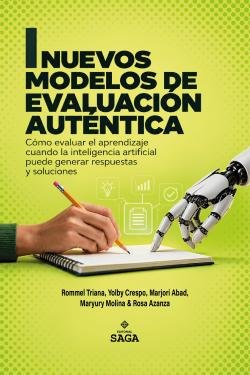
La inteligencia artificial generativa ha alterado las condiciones bajo las cuales docentes e instituciones interpretan las evidencias de aprendizaje. Nuevos modelos de evaluación auténtica propone una revisión académica de los criterios, instrumentos y prácticas utilizados para valorar conocimientos, competencias, razonamiento y desempeño cuando una respuesta técnicamente correcta puede provenir de sistemas automatizados. El libro desplaza la atención desde el producto entregado hacia la trazabilidad del pensamiento, la argumentación, la toma de decisiones, la transferencia y la capacidad de justificar procesos intelectuales. A lo largo de cinco capítulos se articulan modelos de tareas auténticas, problemas abiertos, simulaciones, defensas orales, portafolios de progresión, rúbricas dinámicas y evidencias multimodales. La inteligencia artificial adquiere una función pedagógica delimitada: puede apoyar la retroalimentación, contrastar perspectivas y ampliar procesos de revisión sin reemplazar el juicio educativo. La obra también examina la autoría académica, la transparencia en el uso de herramientas generativas y los niveles autorizados de asistencia artificial. Su propuesta orienta el diseño de sistemas evaluativos centrados en evidencias verificables de comprensión y desempeño. Docentes, investigadores y responsables institucionales encontrarán criterios para renovar la evaluación, preservar la integridad académica y reconocer la contribución intelectual humana dentro de entornos educativos mediados por inteligencia artificial con rigor académico.
Ahangama, N. (2026). Designing assessments in the generative AI era: A tailored assessment framework for ICT tertiary education. International Journal of Educational Technology in Higher Education, 23, Article 9. https://doi.org/10.1186/s41239-026-00582-0
Bower, M., Torrington, J., Lai, J. W. M., Petocz, P., & Alfano, M. (2024). How should we change teaching and assessment in response to increasingly powerful generative artificial intelligence? Outcomes of the ChatGPT teacher survey. Education and Information Technologies, 29, 15403–15439. https://doi.org/10.1007/s10639-023-12405-0
Coates, H., Croucher, G., & Calderon, A. (2025). Governing academic integrity: Ensuring the authenticity of higher thinking in the era of generative artificial intelligence. Journal of Academic Ethics, 23, 2015–2028. https://doi.org/10.1007/s10805-025-09639-7
Combrinck, C., & Loubser, N. (2025). Student self-reflection as a tool for managing GenAI use in large class assessment. Discover Education, 4, Article 72. https://doi.org/10.1007/s44217-025-00461-2
Delcker, J., Heil, J., & Ifenthaler, D. (2025). Evidence-based development of an instrument for the assessment of teachers’ self-perceptions of their artificial intelligence competence. Educational Technology Research and Development, 73, 115–133. https://doi.org/10.1007/s11423-024-10418-1
Fischer, I., Sweeney, S., Lucas, M., & Gupta, N. (2024). Making sense of generative AI for assessments: Contrasting student claims and assessor evaluations. The International Journal of Management Education, 22(3), 101081. https://doi.org/10.1016/j.ijme.2024.101081
Foung, D., Lin, L., & Chen, J. (2024). Reinventing assessments with ChatGPT and other online tools: Opportunities for GenAI-empowered assessment practices. Computers and Education: Artificial Intelligence, 6, 100250. https://doi.org/10.1016/j.caeai.2024.100250
Gruenhagen, J. H., Sinclair, P. M., Carroll, J.-A., Baker, P. R. A., Wilson, A., & Demant, D. (2024). The rapid rise of generative AI and its implications for academic integrity: Students’ perceptions and use of chatbots for assistance with assessments. Computers and Education: Artificial Intelligence, 7, 100273. https://doi.org/10.1016/j.caeai.2024.100273
Gustilo, L., Ong, E., & Lapinid, M. R. (2024). Algorithmically-driven writing and academic integrity: Exploring educators’ practices, perceptions, and policies in AI era. International Journal for Educational Integrity, 20, Article 3. https://doi.org/10.1007/s40979-024-00153-8
Heil, J., Ifenthaler, D., Cooper, M., Mascia, M. L., Conti, R., & Penna, M. P. (2025). Students’ perceived impact of GenAI tools on learning and assessment in higher education: The role of individual AI competence. Smart Learning Environments, 12, Article 37. https://doi.org/10.1186/s40561-025-00395-0
Katsampoxaki-Hodgetts, K. (2026). Enacted AI literacy towards epistemic visibility; Embedding human-AI design as assessment-as-learning in pre-service science teachers’ lesson redesign. Research in Science Education. https://doi.org/10.1007/s11165-026-10360-7
Kizilcec, R. F., Huber, E., Papanastasiou, E. C., Cram, A., Makridis, C. A., Smolansky, A., Zeivots, S., & Raduescu, C. (2024). Perceived impact of generative AI on assessments: Comparing educator and student perspectives in Australia, Cyprus, and the United States. Computers and Education: Artificial Intelligence, 7, 100269. https://doi.org/10.1016/j.caeai.2024.100269
Kulgemeyer, C., Riese, J., Vogelsang, C., Buschhüter, D., Borowski, A., Weißbach, A., Jordans, M., Reinhold, P., & Schecker, H. (2023). How authenticity impacts validity: Developing a model of teacher education assessment and exploring the effects of the digitisation of assessment methods. Zeitschrift für Erziehungswissenschaft. https://doi.org/10.1007/s11618-023-01154-y
König, J., Lindmeier, A., Zlatkin-Troitschanskaia, O., & Borowski, A. (2023). The transfer of digitalized teaching-learning and assessment tools in higher education: Approaches and best practices. Zeitschrift für Erziehungswissenschaft, 26, 579–584. https://doi.org/10.1007/s11618-023-01172-w
Langer, M., Baum, K., & Schlicker, N. (2025). Effective human oversight of AI-based systems: A signal detection perspective on the detection of inaccurate and unfair outputs. Minds and Machines, 35, Article 1. https://doi.org/10.1007/s11023-024-09701-0
Mekheimer, M. (2025). Generative AI-assisted feedback and EFL writing: A study on proficiency, revision frequency and writing quality. Discover Education, 4, Article 170. https://doi.org/10.1007/s44217-025-00602-7
Nguyen, H., & Hayward, J. (2024). Applying generative artificial intelligence to critiquing science assessments. Journal of Science Education and Technology. https://doi.org/10.1007/s10956-024-10177-x
Norgaila, E., Daniela, L., & Kalniņa, D. (2026). Reflective prompt engineering for assessment rubric optimization: An empirical study of human–AI alignment. Technology, Knowledge and Learning, 31, 1023–1038. https://doi.org/10.1007/s10758-026-09979-2
Oates, A., & Johnson, D. (2025). ChatGPT in the classroom: Evaluating its role in fostering critical evaluation skills. International Journal of Artificial Intelligence in Education, 35, 1793–1824. https://doi.org/10.1007/s40593-024-00452-8
Pentland, S. J., Lowenthal, P. R., & Krier, K. (2026). Asynchronous oral assessments: Enhancing integrity, engagement, and communication in the AI era. Educational Technology Research and Development. https://doi.org/10.1007/s11423-026-10677-0
Peters, M., & Angelov, D. (2025). Redefining assessment tasks to promote students’ creativity and integrity in the age of generative artificial intelligence. International Journal for Educational Integrity. https://doi.org/10.1007/s40979-025-00201-x
Tempelaar, D., Rienties, B., & Giesbers, B. (2024). Dispositional learning analytics and formative assessment: An inseparable twinship. International Journal of Educational Technology in Higher Education, 21, Article 57. https://doi.org/10.1186/s41239-024-00489-8
Torres-Diaz, J. C., Duart, J., Rivera, D., & Beltran Flandoli, A. (2025). Artificial intelligence and academic integrity: Exploring plagiarism in Ecuadorian universities. International Journal for Educational Integrity, 21, Article 35. https://doi.org/10.1007/s40979-025-00209-3
Vlachopoulos, D., & Makri, A. (2024). A systematic literature review on authentic assessment in higher education: Best practices for the development of 21st century skills, and policy considerations. Studies in Educational Evaluation, 83, 101425. https://doi.org/10.1016/j.stueduc.2024.101425
Waltzer, T., Pilegard, C., & Heyman, G. D. (2024). Can you spot the bot? Identifying AI-generated writing in college essays. International Journal for Educational Integrity. https://doi.org/10.1007/s40979-024-00158-3
Williams, A. (2024). Comparison of generative AI performance on undergraduate and postgraduate written assessments in the biomedical sciences. International Journal of Educational Technology in Higher Education. https://doi.org/10.1186/s41239-024-00485-y
Xia, Q., Weng, X., Ouyang, F., Lin, T. J., & Chiu, T. K. F. (2024). A scoping review on how generative artificial intelligence transforms assessment in higher education. International Journal of Educational Technology in Higher Education, 21, Article 40. https://doi.org/10.1186/s41239-024-00468-z
Yang, A. C. M., Flanagan, B., & Ogata, H. (2022). Adaptive formative assessment system based on computerized adaptive testing and the learning memory cycle for personalized learning. Computers and Education: Artificial Intelligence, 3, 100104. https://doi.org/10.1016/j.caeai.2022.100104
Zhao, H., & Dang, T. N. Y. (2026). Transforming written assessment design to embrace AI: What needs to be changed to encourage higher-order critical thinking. Education and Information Technologies, 31, 1909–1931. https://doi.org/10.1007/s10639-025-13870-5
Zhuang, Y., Zhao, R., Xie, Z., & Yu, P. L. H. (2025). Enhancing language learning through generative AI feedback on picture-cued writing tasks. Computers and Education: Artificial Intelligence, 9, 100450. https://doi.org/10.1016/j.caeai.2025.100450
Vol. 3 Núm. 3 (2026)
Vol. 3 Núm. 2 (2026)









 10 de agosto 232 entre Almendros y Mangos, Cdla. Alborada sector 2, Machala, Ecuador
 editorialsaga.ec@gmail.com
 +593962679148
