Vol. 3 Núm. 3 (2026) 
Vol. 3 Núm. 2 (2026) 

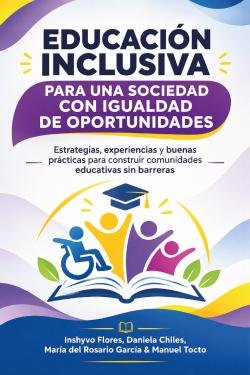
La educación inclusiva constituye un principio fundamental para garantizar el derecho al aprendizaje y la igualdad de oportunidades en el sistema educativo ecuatoriano. La presente obra examina los fundamentos conceptuales y las prácticas pedagógicas que favorecen la construcción de comunidades educativas inclusivas en los niveles de educación básica y bachillerato. Desde una perspectiva crítica y participativa, aborda la diversidad humana y las barreras institucionales que limitan el acceso y la permanencia escolar. Analiza la innovación pedagógica mediante el Diseño Universal para el Aprendizaje y la evaluación inclusiva como recursos para responder a las necesidades del estudiantado. Asimismo, estudia la accesibilidad y el bienestar socioemocional como dimensiones vinculadas con la convivencia democrática y la participación educativa. Se profundiza en la corresponsabilidad de docentes y familias para fortalecer trayectorias escolares equitativas. La obra recupera experiencias y buenas prácticas desarrolladas en entornos educativos diversos, con especial atención a las condiciones sociales y culturales del Ecuador. Finalmente, plantea mecanismos de seguimiento y propuestas de mejora institucional orientadas a transformar las prácticas educativas. Su contenido aporta fundamentos teóricos y herramientas pedagógicas para promover una educación de calidad que reconozca las diferencias individuales y garantice oportunidades reales de aprendizaje para todos.
Ain, G. (2025). Parental involvement and barriers in transitional services for students with autism spectrum disorder in Saudi schools: A mixed-methods study. Frontiers in Education, 10, Article 1647206. https://doi.org/10.3389/feduc.2025.1647206
Alkeraida, A. (2026). School counselors’ self-efficacy in addressing bullying of students with disabilities in mainstream schools: Predictors and implications. Frontiers in Education, 11, Article 1820270. https://doi.org/10.3389/feduc.2026.1820270
Aslan, E., & Mukasheva, A. (2026). Does parental involvement affect learning outcomes in students with mild special educational needs? Cross-sectional evidence from inclusive settings. Frontiers in Education, 11, Article 1860083. https://doi.org/10.3389/feduc.2026.1860083
Basister, M. P., Petersson, J., & Baconguis, R. D. T. (2025). Educational innovations for an inclusive learning environment: Insights from the teachers’ collaboration through lesson study. Frontiers in Education, 10, Article 1610749. https://doi.org/10.3389/feduc.2025.1610749
Bourke, R. (2023). Children’s rights and their evidence as a force for inclusion in uncertain times. Frontiers in Education, 8, Article 1027493. https://doi.org/10.3389/feduc.2023.1027493
CAST. (2024). Universal Design for Learning guidelines version 3.0. https://udlguidelines.cast.org/
Franzen, K., Moschner, B., & Hellmich, F. (2024). Predictors of primary school teachers’ self-efficacy beliefs for inclusive education. Frontiers in Education, 9, Article 1437839. https://doi.org/10.3389/feduc.2024.1437839
Garcia Ramos, J., & Wilson-Kennedy, Z. (2024). Promoting equity and addressing concerns in teaching and learning with artificial intelligence. Frontiers in Education, 9, Article 1487882. https://doi.org/10.3389/feduc.2024.1487882
Machkour, M., El Jihaoui, M., Lamalif, L., Faris, S., & Mansouri, K. (2025). Toward an adaptive learning assessment pathway. Frontiers in Education, 10, Article 1498233. https://doi.org/10.3389/feduc.2025.1498233
Mprah, W. K., et al. (2024). Exploring the perceived knowledge of teacher educators and pre-service teachers on the differentiated instruction practices of teacher educators. Frontiers in Education, 9, Article 1356675. https://doi.org/10.3389/feduc.2024.1356675
Murillo-Jiménez, H., Centeno-Alarcón, M., Buele, J., & Yumbla, F. (2025). Analyzing barriers to the effective implementation of technological tools in inclusive education: A scoping review. Frontiers in Education, 10, Article 1687664. https://doi.org/10.3389/feduc.2025.1687664
Navas-Bonilla, C. del R., Guerra-Arango, J. A., Oviedo-Guado, D. A., & Murillo-Noriega, D. E. (2025). Inclusive education through technology: A systematic review of types, tools and characteristics. Frontiers in Education, 10, Article 1527851. https://doi.org/10.3389/feduc.2025.1527851
Oyewole, K. A., Resnick, A. F., Farrell, C. C., Wentworth, L., Furtak, E. M., Borko, H., Wright, K., Weiss, J. C., & Arce-Trigatti, P. (2025). From a niche to the norm: A framework for action to empower collaborative education research. Frontiers in Education, 10, Article 1661496. https://doi.org/10.3389/feduc.2025.1661496
Peterson, J. M., & Jensen, M. T. (2025). Teacher self-efficacy in relation to cultural and linguistic diversity in K–12 settings: A systematic review. Frontiers in Education, 10, Article 1531481. https://doi.org/10.3389/feduc.2025.1531481
Quintero, J., Baldiris, S., & Cerón, J. (2025). CooperAR: Supporting the design and implementation of augmented inclusive educational scenarios. Frontiers in Education, 10, Article 1571104. https://doi.org/10.3389/feduc.2025.1571104
Saxton, J., Matthews, J., Winterburn, I., Casey, H., Zylbersztejn, A., Barnes, S., Hall, P., Tripp, C., Black-Hawkins, K., & Ford, T. (2025). Exploring the experiences and outcomes of children and young people receiving support for special educational needs over time in England: A qualitative study. Frontiers in Education, 10, Article 1564583. https://doi.org/10.3389/feduc.2025.1564583
Segovia-Lagos, P., Alquinta, C., Bustamante, F., Galdames, E., & Márquez, C. (2026). Characterization of educational practices for addressing cultural diversity: An analysis from the perspectives of critical interculturality and the inclusion approach. Frontiers in Education, 11, Article 1882636. https://doi.org/10.3389/feduc.2026.1882636
Shewchuk, S., & Vilceus, S. (2025). Examining equity in (education) collaborations: A conceptual framework. Frontiers in Education, 10, Article 1677571. https://doi.org/10.3389/feduc.2025.1677571
Shuakbayeva, Z., Ospanova, B., Kalkeyeva, K., Orazaliyeva, R., & Nurekenova, A. (2025). Replicating the pathways to resilience: Demographic predictors, self-efficacy, and inclusive teaching among pre-service teachers. Frontiers in Education, 10, Article 1640288. https://doi.org/10.3389/feduc.2025.1640288
To, J., Aluquin, D., & Tan, K. H. K. (2025). Making student voice heard in dialogic feedback: Feedback design matters. Frontiers in Education, 10, Article 1550328. https://doi.org/10.3389/feduc.2025.1550328
Torres-Zaragoza, L. (2025). Moroccan Muslim students’ cultural and religious diversity recognition in Spanish schools: A critical multiculturalism analysis from their mothers’ perspectives. Frontiers in Education, 10, Article 1649446. https://doi.org/10.3389/feduc.2025.1649446
Townend, G., Alonzo, D., Knipe, S., & Baker, S. (2025). What does the international literature say about assessment practice for equitable learning outcomes for educationally disadvantaged high school students? Frontiers in Education, 10, Article 1536485. https://doi.org/10.3389/feduc.2025.1536485
Turganbayeva, B., Adilzhanova, K., Sovetkanova, D., & Kadirsizova, S. (2026). Inclusive education: The role of parents and the importance of pedagogical and psychological support. Frontiers in Education, 11, Article 1866833. https://doi.org/10.3389/feduc.2026.1866833
UNESCO. (2017). A guide for ensuring inclusion and equity in education. https://unesdoc.unesco.org/ark:/48223/pf0000248254
UNESCO. (2020). Informe de seguimiento de la educación en el mundo 2020: Inclusión y educación: Todos y todas sin excepción. https://www.unesco.org/gem-report/es/publication/inclusion-and-education
UNICEF Office of Strategy and Evidence Innocenti. (2026). Learning is for everyone: Towards inclusive education for children with disabilities. UNICEF. https://www.unicef.org/innocenti/es/reports/learning-everyone-global-report
Weddle, H., Hopkins, M., Shanahan, K., & Stern, S. (2025). People, politics, and pivots: Sustaining research-practice partnership collaboration. Frontiers in Education, 10, Article 1657547. https://doi.org/10.3389/feduc.2025.1657547
Wheeler, M. (2026a). From provision to belonging: A conceptual framework for belonging-led inclusion in mainstream schools. Frontiers in Education, 11, Article 1914499. https://doi.org/10.3389/feduc.2026.1914499
Wheeler, M. (2026b). Sustaining participation in inclusive education: A conceptual model for recognising hidden vulnerability. Frontiers in Education, 11, Article 1830274. https://doi.org/10.3389/feduc.2026.1830274
Vol. 3 Núm. 3 (2026)
Vol. 3 Núm. 2 (2026)










 10 de agosto 232 entre Almendros y Mangos, Cdla. Alborada sector 2, Machala, Ecuador
 editorialsaga.ec@gmail.com
 +593962679148
