Vol. 3 Núm. 3 (2026) 
Vol. 3 Núm. 2 (2026) 

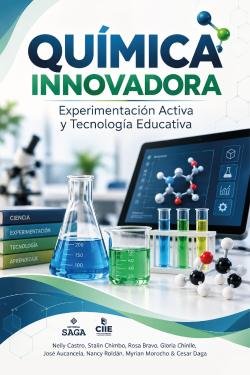
Química Innovadora: Experimentación Activa y Tecnología Educativa presenta una propuesta académica orientada a transformar la enseñanza de la química mediante experiencias experimentales participativas y recursos tecnológicos que favorecen la construcción del conocimiento científico. La obra examina metodologías activas que promueven la indagación y el razonamiento químico a partir de situaciones vinculadas con la realidad educativa. Su desarrollo articula prácticas de laboratorio a pequeña escala con principios de química verde y procedimientos de investigación aplicada. Asimismo, aborda el empleo de simuladores interactivos y laboratorios virtuales para representar fenómenos moleculares cuya comprensión requiere distintos niveles de abstracción. La inteligencia artificial adquiere relevancia como recurso para personalizar actividades y proporcionar retroalimentación durante el aprendizaje. Desde una perspectiva interdisciplinaria, se estudia la integración de sensores digitales y sistemas de instrumentación accesibles en proyectos experimentales que relacionan la química con otras disciplinas científicas. La evaluación de competencias ocupa un espacio significativo mediante rúbricas digitales y portafolios electrónicos que permiten documentar procesos investigativos. El libro propone criterios pedagógicos para diseñar experiencias educativas sustentadas en evidencias y orientadas al desarrollo de habilidades científicas. Su contenido está dirigido a docentes e investigadores interesados en renovar las prácticas de enseñanza mediante la experimentación y la tecnología educativa.
Andrews, J. L., de Los Rios, J. P., Rayaluru, M., Lee, S., Mai, L., Schusser, A., & Mak, C. H. (2020). Experimenting with at-home general chemistry laboratories during the COVID-19 pandemic. Journal of Chemical Education, 97(7), 1887–1894. https://doi.org/10.1021/acs.jchemed.0c00483
Cao, J., Guan, H., & Jiang, J. (2025). A review of the literature on project-based learning in high school chemistry over the past decade in the Journal of Chemical Education. Journal of Chemical Education, 102(2), 599–614. https://doi.org/10.1021/acs.jchemed.4c00886
Chan, P., Van Gerven, T., Dubois, J.-L., & Bernaerts, K. (2021). Virtual chemical laboratories: A systematic literature review of research, technologies and instructional design. Computers and Education Open, 2, Article 100053. https://doi.org/10.1016/j.caeo.2021.100053
Chen, K., Lu, Y., Ma, J., Cao, M., & Ling, Y. (2026). An AI-assisted interactive video-based system (AI-LabEyes) for enhancing visualization, formative feedback, and collaborative learning in chemistry laboratory instruction. Journal of Chemical Education, 103(10), 6035–6040. https://doi.org/10.1021/acs.jchemed.6c00294
Donis, K., Aikens, M. L., Swamy, U., Delgado, M., Gillespie, M., Graves, P., & Eddy, S. L. (2024). Learning assistants and instructors provide social support that influences student engagement differently in undergraduate active learning chemistry courses. Journal of Chemical Education. https://doi.org/10.1021/acs.jchemed.3c01137
Hood, H. K., Smit, E., & Arderne, C. (2026). Sustainable and cost-effective 3D-printed calorimeters for undergraduate laboratory experiments. Journal of Chemical Education, 103(6), 3432–3436. https://doi.org/10.1021/acs.jchemed.5c00957
Intaraprasit, M., Tawornparcha, P., Veerapong, P., & Limpanuparb, T. (2023). Intuitive small-scale electrochemistry on 24-well plate and 3D-printed cover yielding accurate results. Journal of Chemical Education, 100(8), 3144–3150. https://doi.org/10.1021/acs.jchemed.3c00356
Jegstad, K. M. (2024). Inquiry-based chemistry education: A systematic review. Studies in Science Education, 60(2), 251–313. https://doi.org/10.1080/03057267.2023.2248436
Karpudewan, M., & Daman Huri, N. H. (2023). Interdisciplinary electrochemistry STEM-lab activities replacing the single disciplinary electrochemistry curriculum for secondary schools. Journal of Chemical Education, 100(2), 998–1010. https://doi.org/10.1021/acs.jchemed.2c00469
Khairani, R. N., & Prodjosantoso, A. K. (2023). Application of augmented reality on chemistry learning: A systematic review. Jurnal Penelitian Pendidikan IPA, 9(11), 1221–1228. https://doi.org/10.29303/jppipa.v9i11.4412
Kim, S., Bucholtz, E. C., et al. (2021). Teaching cheminformatics through a collaborative intercollegiate online chemistry course (OLCC). Journal of Chemical Education, 98(2), 416–425. https://doi.org/10.1021/acs.jchemed.0c01035
Krushinski, L. E., Clarke, T. B., & Dick, J. E. (2024). A hands-on approach to understanding electrochemistry for middle and high school students. Journal of Chemical Education, 101(2), 687–692. https://doi.org/10.1021/acs.jchemed.3c00939
Liu, Y. (2022). Effects of a CURE laboratory module on general chemistry students’ perceptions of scientific research, green chemistry, and self-efficacy. Journal of Chemical Education, 99(7), 2588–2596. https://doi.org/10.1021/acs.jchemed.2c00132
Lu, L. T., Clements, K. A., & Obenland, C. A. (2024). A comparative study of two active learning approaches for general chemistry. Journal of Chemical Education, 101(12), 5183–5191. https://doi.org/10.1021/acs.jchemed.4c00638
O’Neil, N. J., & Scott, S. (2021). Approaches to incorporating green chemistry and safety into laboratory culture. Journal of Chemical Education, 98(1), 84–91. https://doi.org/10.1021/acs.jchemed.0c00134
Pino, H., Pastor, V., Grimalt-Álvaro, C., & López, V. (2019). Measuring CO2 with an Arduino: Creating a low-cost, pocket-sized device with flexible applications that yields benefits for students and schools. Journal of Chemical Education, 96(2), 377–381. https://doi.org/10.1021/acs.jchemed.8b00473
Rauf, A., & Ryu, M. (2026). Empowering graduate teaching assistants in chemistry: Collaborative action research and GTAs’ professional agency. Journal of Chemical Education, 103(4), 1743–1754. https://doi.org/10.1021/acs.jchemed.5c00863
Rodemer, M., Franke, J., & Feldon, D. (2026). Good questions, sound measurement? Item-writing quality, psychometric functioning, and competence-level alignment of AI-generated multiple-choice assessments in chemistry education. Frontiers in Education, 11. https://doi.org/10.3389/feduc.2026.1939585
Rodriguez-Vasquez, K. A., Cole, A. M., Yordanova, D., Smith, R., & Kidwell, N. M. (2020). AIRduino: On-demand atmospheric secondary organic aerosol measurements with a mobile Arduino multisensor. Journal of Chemical Education, 97(3), 838–844. https://doi.org/10.1021/acs.jchemed.9b00744
Rootman-le Grange, I. (2018). Action research: Integrating chemistry and scientific communication to foster cumulative knowledge building and scientific communication skills. Journal of Chemical Education, 95(8), 1284–1290. https://doi.org/10.1021/acs.jchemed.7b00958
Roski, M., Ewerth, R., Hoppe, A., & Nehring, A. (2024). Exploring data mining in chemistry education: Building a web-based learning platform for learning analytics. Journal of Chemical Education, 101(3). https://doi.org/10.1021/acs.jchemed.3c00794
Switzer, K., Onbey, H., Schreck, J. O., & Dabke, R. B. (2025). Amperometric method to determine the active ingredients in household products: A set of undergraduate laboratory titration experiments. Journal of Chemical Education, 102(6), 2415–2421. https://doi.org/10.1021/acs.jchemed.4c00949
Taber, K. S. (2013). Revisiting the chemistry triplet: Drawing upon the nature of chemical knowledge and the psychology of learning to inform chemistry education. Chemistry Education Research and Practice, 14, 156–168. https://doi.org/10.1039/C3RP00012E
Talanquer, V. (2025). Exploring the plurality of chemical modeling: Implications for chemistry teaching. Journal of Chemical Education, 102(8), 3090–3095. https://doi.org/10.1021/acs.jchemed.5c00244
Tang, H., & Abraham, M. R. (2016). Effect of computer simulations at the particulate and macroscopic levels on students’ understanding of the particulate nature of matter. Journal of Chemical Education, 93(1), 31–38. https://doi.org/10.1021/acs.jchemed.5b00599
Tassoti, S. (2024). Assessment of students use of generative artificial intelligence: Prompting strategies and prompt engineering in chemistry education. Journal of Chemical Education, 101(6), 2475–2482. https://doi.org/10.1021/acs.jchemed.4c00212
Tay, K. S. (2024). Integrating maker education into the research project of undergraduate chemistry program: Low-cost Arduino-based 3D printed autotitrator. Journal of Chemical Education, 101(12), 5430–5436. https://doi.org/10.1021/acs.jchemed.4c00486
Twizeyimana, E., Uworwabayeho, A., & Niyonzima, F. N. (2026). From cookbook laboratories to scaffolded inquiry: A systematic review of inquiry-based learning in chemistry education. SAGE Open. https://doi.org/10.1177/21582440261488456
Wan, L., Zhong, H., Hu, J., & Chen, X. (2026). Integrating STEAM education into project based learning by exploring ethyl acetate in nail polish. Journal of Chemical Education, 103(6), 3325–3332. https://doi.org/10.1021/acs.jchemed.5c01642
Ying, J., Qiu, J., Wu, Y., Zhao, L., & Bai, Y. (2023). An investigation on the application of a competency assessment system in a blended learning course “Organic Chemistry Laboratory”. Journal of Chemical Education. https://doi.org/10.1021/acs.jchemed.3c00456
Vol. 3 Núm. 3 (2026)
Vol. 3 Núm. 2 (2026)








 10 de agosto 232 entre Almendros y Mangos, Cdla. Alborada sector 2, Machala, Ecuador
 editorialsaga.ec@gmail.com
 +593962679148
