Vol. 3 Núm. 3 (2026) 
Vol. 3 Núm. 2 (2026) 

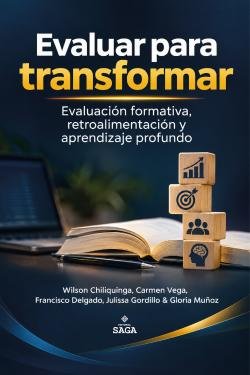
Evaluar para transformar: Evaluación formativa, retroalimentación y aprendizaje profundo examina la evaluación educativa desde una perspectiva epistemológica y pedagógica orientada a comprender los procesos mediante los cuales los estudiantes construyen conocimientos y desarrollan capacidades para actuar con autonomía. La obra analiza la relación entre evaluación formativa y pensamiento crítico mediante enfoques que reconocen la participación estudiantil como componente de la transformación educativa. Su desarrollo conceptual aborda el diseño de experiencias evaluativas auténticas y la articulación entre criterios de calidad y evidencias de aprendizaje. La retroalimentación adquiere especial relevancia como práctica dialógica que favorece la autorregulación y la reconstrucción reflexiva del conocimiento. Asimismo, se examinan las posibilidades pedagógicas de la inteligencia artificial y los entornos digitales para diversificar los procedimientos evaluativos sin desatender sus implicaciones éticas. El análisis incorpora la metacognición y el juicio evaluativo como capacidades vinculadas al aprendizaje profundo. Desde una perspectiva institucional, el libro estudia la transformación de las culturas evaluativas mediante la investigación docente y la toma de decisiones sustentada en evidencias. Su propuesta académica articula reflexión teórica y aplicación pedagógica para fortalecer prácticas de evaluación comprometidas con la equidad educativa y el desarrollo integral del estudiante.
Aras, S. (2024). Building up formative assessment practices through action research: A study in early childhood teacher education. Journal of Early Childhood Teacher Education, 45(1), 2–15. https://doi.org/10.1080/10901027.2023.2217413
Barnes, M., Lafferty, K., & Li, B. (2024). Assessing twenty-first century competencies: Can students lead and facilitate the co-construction process? Educational Review, 76(4), 691–709. https://doi.org/10.1080/00131911.2022.2142524
Carless, D. (2022). From teacher transmission of information to student feedback literacy: Activating the learner role in feedback processes. Active Learning in Higher Education, 23(2), 143–153. https://doi.org/10.1177/1469787420945845
Chen, G., Wang, X., & Wang, L. (2023). Developing assessment literacy among trainee translators: Scaffolding self and peer assessment as an intervention. Assessment & Evaluation in Higher Education, 48(6), 888–902. https://doi.org/10.1080/02602938.2022.2142515
Deneen, C. C., & Hoo, H.-T. (2023). Connecting teacher and student assessment literacy with self-evaluation and peer feedback. Assessment & Evaluation in Higher Education, 48(2), 214–226. https://eric.ed.gov/?id=EJ1379450
Graham, A. I., Harner, C., & Marsham, S. (2022). Can assessment-specific marking criteria and electronic comment libraries increase student engagement with assessment and feedback? Assessment & Evaluation in Higher Education, 47(7), 1071–1086. https://doi.org/10.1080/02602938.2021.1986468
Harris, L. R., Adie, L., & Wyatt-Smith, C. (2022). Learning progression–based assessments: A systematic review of student and teacher uses. Review of Educational Research, 92(6). https://doi.org/10.3102/00346543221081552
Hui, L., Ippolito, K., Sarsfield, M., & Charalambous, M. (2024). Using a self-reflective ePortfolio and feedback dialogue to understand and address problematic feedback expectations. Assessment & Evaluation in Higher Education, 49(3), 334–347. https://doi.org/10.1080/02602938.2023.2232960
Kaldaras, L., Akaeze, H. O., & Reckase, M. D. (2024). Developing valid assessments in the era of generative artificial intelligence. Frontiers in Education, 9, Article 1399377. https://doi.org/10.3389/feduc.2024.1399377
Kaliisa, R., Jivet, I., & Prinsloo, P. (2023). A checklist to guide the planning, designing, implementation, and evaluation of learning analytics dashboards. International Journal of Educational Technology in Higher Education, 20, Article 28. https://doi.org/10.1186/s41239-023-00394-6
Ketonen, L., & Nieminen, J. H. (2023). Supporting student teachers’ reflection through assessment: The case of reflective podcasts. Teaching and Teacher Education, 124, Article 104039. https://doi.org/10.1016/j.tate.2023.104039
Kilgour, P., Northcote, M., Williams, A., & Kilgour, A. (2020). A plan for the co-construction and collaborative use of rubrics for student learning. Assessment & Evaluation in Higher Education, 45(1), 140–153. https://doi.org/10.1080/02602938.2019.1614523
Kwong, C.-Y. C., & Churchill, D. (2023). Applying the activity theory framework to analyse the use of ePortfolios in an International Baccalaureate Middle Years Programme Sciences classroom: A longitudinal multiple-case study. Computers & Education, 200, Article 104792. https://doi.org/10.1016/j.compedu.2023.104792
Lee, S. S., & Moore, R. L. (2024). Harnessing generative AI (GenAI) for automated feedback in higher education: A systematic review. Online Learning, 28(3), 82–106. https://eric.ed.gov/?id=EJ1446868
Man, D., Kong, B., & Chau, M. H. (2024). Developing student feedback literacy through peer review training. RELC Journal, 55(2). https://doi.org/10.1177/00336882221078380
Matthews, K. E., Sherwood, C., Enright, E., & Cook-Sather, A. (2024). What do students and teachers talk about when they talk together about feedback and assessment? Expanding notions of feedback literacy through pedagogical partnership. Assessment & Evaluation in Higher Education, 49(1), 26–38. https://doi.org/10.1080/02602938.2023.2170977
Nicol, D., & Kushwah, L. (2024). Shifting feedback agency to students by having them write their own feedback comments. Assessment & Evaluation in Higher Education, 49(3), 419–439. https://doi.org/10.1080/02602938.2023.2265080
Paulsen, L., & Lindsay, E. (2024). Learning analytics dashboards are increasingly becoming about learning and not just analytics—A systematic review. Education and Information Technologies, 29, 14279–14308. https://doi.org/10.1007/s10639-023-12401-4
Pont-Niclòs, I., Martín-Ezpeleta, A., & Echegoyen-Sanz, Y. (2024). Scientific creativity in secondary students and its relationship with STEM-related attitudes, engagement and work intentions. Frontiers in Education, 9, Article 1382541. https://doi.org/10.3389/feduc.2024.1382541
Rott, B. (2021). Inductive and deductive justification of knowledge: Epistemological beliefs and critical thinking at the beginning of studying mathematics. Educational Studies in Mathematics, 106, 117–132. https://doi.org/10.1007/s10649-020-10004-1
Sadler, I., Reimann, N., & Sambell, K. (2023). Feedforward practices: A systematic review of the literature. Assessment & Evaluation in Higher Education, 48(3), 305–320. https://doi.org/10.1080/02602938.2022.2073434
Sakr, A., & Abdullah, T. (2024). Virtual, augmented reality and learning analytics impact on learners, and educators: A systematic review. Education and Information Technologies, 29, 19913–19962. https://doi.org/10.1007/s10639-024-12602-5
Simbeck, K. (2024). They shall be fair, transparent, and robust: Auditing learning analytics systems. AI and Ethics, 4, 555–571. https://doi.org/10.1007/s43681-023-00292-7
Stotsky, A., & Wik, T. (2024). Automatic generation of examinations in the automatic control courses: Decision support Matlab/LATEX toolkit for stepwise constructive alignment. IFAC-PapersOnLine, 58(16), 47–52. https://doi.org/10.1016/j.ifacol.2024.08.460
Vlachopoulos, D., & Makri, A. (2024). A systematic literature review on authentic assessment in higher education: Best practices for the development of 21st century skills, and policy considerations. Studies in Educational Evaluation, 83, Article 101425. https://doi.org/10.1016/j.stueduc.2024.101425
Winstone, N. E., & Nash, R. A. (2023). Toward a cohesive psychological science of effective feedback. Educational Psychologist, 58(3), 111–129. https://doi.org/10.1080/00461520.2023.2224444
Wolterinck, C., Poortman, C., Schildkamp, K., & Visscher, A. (2024). Assessment for learning: Developing the required teacher competencies. European Journal of Teacher Education, 47(4), 711–729. https://doi.org/10.1080/02619768.2022.2124912
Zhan, Y. (2022). Developing and validating a student feedback literacy scale. Assessment & Evaluation in Higher Education, 47(7), 1087–1100. https://doi.org/10.1080/02602938.2021.2001430
Zhang, W., Li, Y., & Zhang, W. (2024). More pain, more gain? Extricating the effect of student involvement in rubric co-construction. Assessment & Evaluation in Higher Education, 49(6), 838–850. https://doi.org/10.1080/02602938.2024.2331177
Zhang, Z., & Huang, X. (2024). Exploring the impact of the adaptive gamified assessment on learners in blended learning. Education and Information Technologies, 29, 21869–21889. https://doi.org/10.1007/s10639-024-12708-w
Vol. 3 Núm. 3 (2026)
Vol. 3 Núm. 2 (2026)








 10 de agosto 232 entre Almendros y Mangos, Cdla. Alborada sector 2, Machala, Ecuador
 editorialsaga.ec@gmail.com
 +593962679148
